
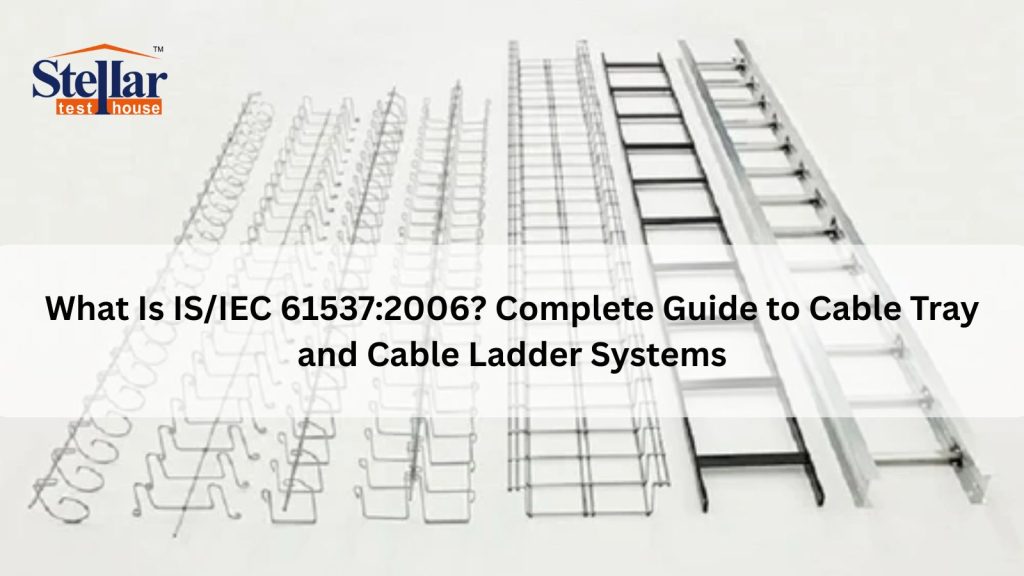
Modern electrical installations rely heavily on well-designed cable management systems. As power, control, and data cables increase in quantity and complexity, safety and structural reliability become critical. To ensure uniform performance and safety, the international standard IS/IEC 61537:2006 defines the requirements for cable tray systems and cable ladder systems used in electrical installations.
This article explains the standard in clear terms—what it covers, why it matters, where it applies, and how testing ensures compliance.
Understanding IS/IEC 61537:2006
IS/IEC 61537:2006 is the Indian adoption of the IEC standard that specifies performance, construction, and testing requirements for cable management systems. The standard applies to:
- Cable tray systems
- Cable ladder systems
- Their associated fittings and supports
These systems provide mechanical support and safe routing for insulated cables in electrical installations.
The standard focuses on mechanical strength, load capacity, durability, and safety, rather than electrical performance.
Why IS/IEC 61537 Matters in Cable Management
Cable trays and ladders carry significant cable loads over long spans. If the system fails, it can lead to:
- Cable damage
- Fire hazards
- Costly shutdowns
- Safety risks for personnel
IS/IEC 61537 addresses these risks by defining minimum performance requirements and standardized test methods. Compliance ensures predictable behavior under real installation conditions.
Key Components Covered Under IS/IEC 61537
The standard applies to complete cable management assemblies, including:
1. Cable Tray Systems
Used for supporting power, control, and communication cables in horizontal or vertical runs. Trays allow easy cable installation and maintenance.
2. Cable Ladder Systems
Designed for heavy-duty applications where high cable loads and long spans are involved. Ladders offer excellent ventilation and strength.
3. Fittings and Accessories
Bends, tees, reducers, couplers, and supports form part of the tested system.
Testing Requirements as per IS/IEC 61537:2006
Compliance with the standard depends on laboratory testing. An IS/IEC 61537 testing lab evaluates whether cable trays and ladders meet performance requirements under defined conditions.
Common Tests Include:
- Mechanical load test
- Deflection test
- Strength and rigidity evaluation
- Impact resistance (where applicable)
- Verification of safe working load
An accredited IS/IEC 61537 cable tray testing process ensures the system can safely support cables throughout its service life.
Cable Tray Testing: What the Standard Verifies
In a Cable tray system IS IEC 61537 testing lab, trays undergo controlled loading until they reach specified limits. The lab measures:
- Maximum allowable deflection
- Structural stability
- Permanent deformation after load removal
A recognized Cable tray testing laboratory IS IEC 61537 provides documented results that manufacturers and project owners rely on for approval.
Cable Ladder Testing as per IS/IEC 61537
Cable ladders face higher load demands, especially in industrial plants and power stations. Cable ladder testing as per IS IEC 61537 focuses on:
- Load-bearing capacity
- Span performance
- Structural integrity under continuous stress
Cable ladder system compliance testing ensures ladders perform safely even when fully loaded with heavy power cables.
Applications of IS/IEC 61537 Cable Management Systems
IS/IEC 61537-compliant systems are widely used in:
- Power plants
- Oil and gas facilities
- Industrial manufacturing units
- Commercial buildings
- Data centers
- Infrastructure and transportation projects
In these environments, compliance supports both safety and long-term reliability.
Why Testing at a Certified IS IEC 61537 Testing Lab Is Essential
Design calculations alone do not guarantee real-world performance. Laboratory testing validates assumptions and confirms product consistency.
Benefits of testing include:
- Compliance with project specifications
- Increased customer confidence
- Reduced site failures
- Improved product acceptance in tenders
Manufacturers and installers prefer products verified by an experienced IS IEC 61537 testing lab because test reports provide measurable proof of performance.
Choosing the Right Testing Laboratory
When selecting a laboratory for IS/IEC 61537 testing, look for:
- NABL or equivalent accreditation
- Experience with cable management systems
- Proper loading and measurement equipment
- Clear and traceable test reports
A competent lab ensures accurate results and smooth certification processes.
Final Thoughts
IS/IEC 61537:2006 plays a crucial role in ensuring the safety and reliability of cable tray and cable ladder systems. By defining clear testing and performance requirements, the standard helps prevent structural failures and supports safe cable installations.
However, compliance only becomes meaningful when validated through proper laboratory testing. Partnering with a trusted IS/IEC 61537 cable tray testing laboratory ensures that cable management systems perform as intended under real installation conditions.