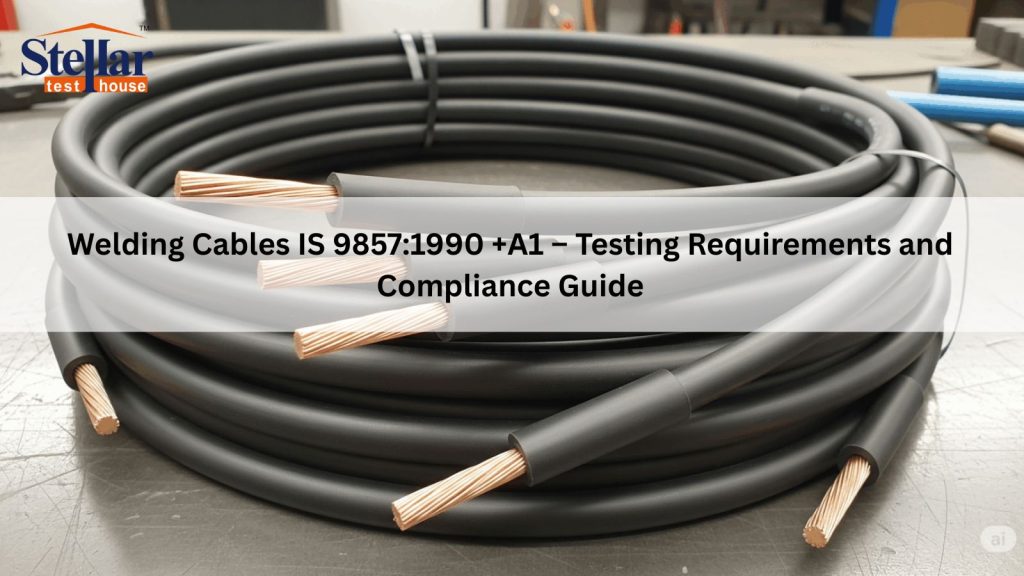
Welding cables play a vital role in industrial and fabrication environments where safety, flexibility, and electrical performance cannot be compromised. These cables must withstand rough handling, high current loads, heat, oil exposure, and mechanical stress. To ensure consistent quality and safe operation, Indian manufacturers follow IS 9857:1990 +A1, the official standard for welding cables.
This guide explains the testing requirements, compliance process, and why certification under IS 9857 matters for manufacturers and users alike.
Overview of IS 9857:1990 +A1 Standard
The IS 9857:1990 +A1 standard defines the construction, material quality, and performance criteria for flexible welding cables used in arc welding applications. It covers cables designed to carry high currents at low voltages while remaining flexible in demanding working conditions.
The standard focuses on:
- Electrical safety
- Mechanical durability
- Thermal resistance
- Long-term performance under repeated bending
Compliance ensures that cables meet industry expectations for reliability and operator safety.
Why Welding Cable Testing Is Essential
Welding environments are harsh. Cables face continuous flexing, accidental dragging, exposure to sparks, and temperature fluctuations. Without proper testing, cable failure can lead to electric shock, fire hazards, or production downtime.
Welding cable testing as per IS 9857 confirms that the product can perform safely under real working conditions. Testing helps manufacturers maintain consistency and gives buyers confidence in product quality.
Key Testing Requirements Under IS 9857
Testing under this standard is conducted at a recognized IS 9857 standard welding cable testing lab using defined procedures and calibrated equipment. The major tests include:
Conductor Resistance Test
This test verifies that the conductor offers proper electrical conductivity and minimizes power loss during operation.
Insulation Resistance and Voltage Test
The insulation must withstand specified voltage levels without breakdown. This ensures electrical safety during welding operations.
Flexibility and Bending Test
Flexible welding cable testing IS 9857 evaluates the cable’s ability to endure repeated bending without cracking or insulation damage.
Tensile Strength and Elongation Test
The insulation and sheath materials are tested for strength and elasticity to ensure durability during handling and installation.
Heat and Oil Resistance Test
Cables are exposed to elevated temperatures and oils commonly found in workshops to confirm material stability.
Each test result contributes to overall compliance with Welding cables IS 9857:1990 +A1 testing requirements.
Role of an IS 9857 Welding Cable Testing Laboratory
Accurate testing depends on the expertise and infrastructure of the laboratory. A certified IS 9857 welding cable testing laboratory follows BIS-approved methods and maintains strict quality controls.
Such laboratories provide:
- Standard-compliant testing procedures
- Detailed and transparent test reports
- Technical guidance for manufacturers
- Support for regulatory and tender requirements
Testing performed at a recognized lab strengthens product credibility in both domestic and institutional markets.
Compliance Benefits for Manufacturers and Buyers
Meeting IS 9857 requirements offers long-term advantages. Manufacturers gain improved product acceptance, while buyers receive safer and more reliable cables.
Key benefits include:
- Enhanced operational safety
- Reduced risk of electrical failure
- Longer service life of welding cables
- Better compliance with industrial safety norms
Certified cables also improve trust in high-risk environments such as shipyards, construction sites, and heavy engineering units.
Conclusion
The Welding Cables IS 9857:1990 +A1 – Testing Requirements and Compliance Guide highlights the importance of standard-based testing in ensuring performance, safety, and durability. From conductor resistance to flexibility and thermal resistance, every test plays a critical role in validating cable quality.
By choosing testing at a qualified IS 9857 standard welding cable testing lab, manufacturers can confidently deliver products that meet regulatory expectations and perform reliably in demanding welding applications.