
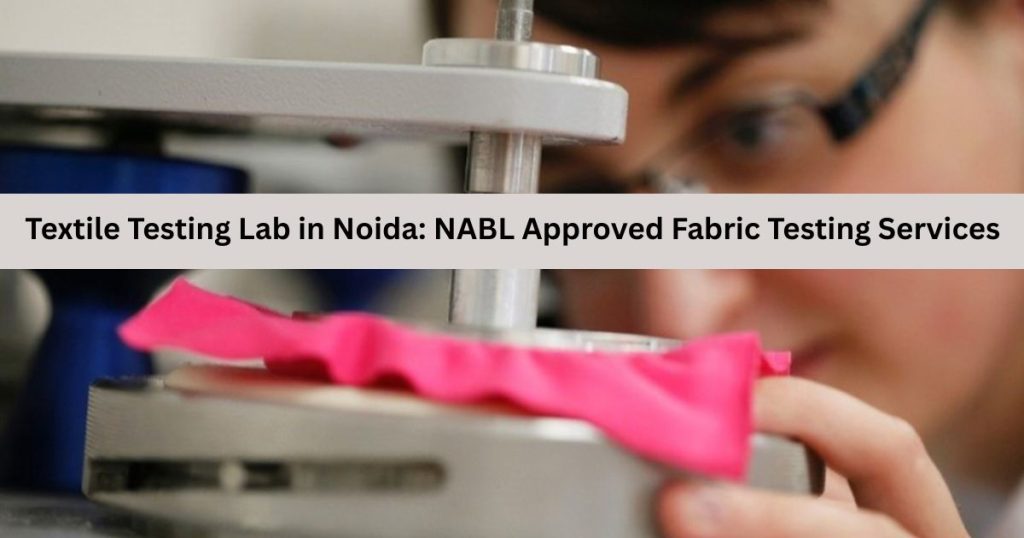
In today’s competitive textile and apparel industry, product quality, durability, safety, and compliance are more important than ever. Manufacturers, exporters, garment brands, retailers, and buyers now require textiles that meet national and international quality standards. This is where a professional Textile Testing Lab plays a critical role.
If you are searching for a reliable Textile testing laboratory in Noida, Stellar Test House offers comprehensive and accurate textile testing solutions for yarns, fabrics, garments, carpets, medical textiles, non-woven products, and industrial textiles. As a trusted Textile Testing Lab in Noida, we provide advanced testing services using modern laboratory equipment and highly experienced technical experts.
Our laboratory follows Indian Standards (IS), ISO standards, and international testing protocols to ensure reliable and accurate results for manufacturers, exporters, and quality assurance teams.
Why Choose Stellar Test House – Best Textile Testing Lab in Noida
Stellar Test House is recognized as a Best Textile testing lab for delivering precise, fast, and standards-compliant textile testing services. Our laboratory supports textile industries with complete testing and inspection solutions for raw materials, finished fabrics, apparel products, technical textiles, and home furnishing products.
Key Advantages of Our Textile Testing Laboratory
- NABL-oriented testing procedures
- Advanced textile testing instruments
- Experienced laboratory professionals
- Fast and accurate reporting
- Testing as per IS, ISO & international standards
- Support for exporters and manufacturers
- Reliable quality assurance solutions
Whether you are looking for a textile testing laboratory near me or a certified Textile Testing Lab in Noida, Stellar Test House provides dependable testing services for all textile sectors.
Mechanical & Physical Testing of Textiles
Mechanical and physical properties determine the durability, performance, and usability of textile materials. Our Textile Testing Lab conducts the following tests:
Breaking Load – IS 1969:2009
Breaking load measures the maximum force required to break a fabric specimen under specified conditions. The result is expressed in Newton (N).
Importance:
- Determines fabric strength
- Essential for industrial fabrics and garments
- Ensures durability during usage
Elongation – IS 1969:2009
Elongation refers to the percentage increase in the length of a fabric specimen at the point of break.
Importance:
- Measures flexibility and stretchability
- Helps evaluate fabric performance under stress
Tear Resistance – IS 6489:1993
This test determines the force required to propagate an existing tear in textile fabric.
Importance:
- Evaluates resistance against tearing
- Critical for uniforms, upholstery, tents, and workwear
Bursting Strength – IS 1966:1975
Bursting strength measures the pressure required to rupture textile materials when pressure is applied uniformly.
Importance:
- Suitable for knitted and non-woven fabrics
- Indicates resistance to multidirectional pressure
Flammability – IS 11871:1986
Flammability testing determines the ignition resistance and combustion behavior of textile products.
Importance:
- Essential for safety compliance
- Important for home textiles, automotive fabrics, and children’s wear
Mass per Unit Area (GSM) – IS 1964:2001
This test measures the weight of fabric per square meter.
Importance:
- Determines fabric density
- Helps maintain production consistency
Thread Count – IS 1963:1981
Thread count refers to the number of warp and weft yarns present per unit area.
Importance:
- Influences fabric texture and quality
- Important for bedsheets, shirting, and premium fabrics
Dimensional Stability Testing
Dimensional stability testing ensures that fabrics maintain their size and shape after washing or soaking.
Dimensional Change After Washing – IS 1313:1984
Measures shrinkage or expansion after washing and agitation.
Importance:
- Ensures garment fitting consistency
- Reduces customer complaints
Dimensional Change Without Agitation – IS 2977:1989
Evaluates dimensional changes after soaking in water without agitation.
Importance:
- Suitable for delicate and knitted fabrics
- Measures relaxation shrinkage
Yarn Properties Testing
Our Textile testing laboratory in Noida performs complete yarn analysis for quality assurance.
Linear Density – IS 1315:1977
Cotton Count System
Number of 768.1-meter hanks per 453.6 grams.
Tex System
Mass in grams per kilometer of yarn.
Importance:
- Determines yarn fineness
- Impacts fabric appearance and performance
Crimp – IS 3442:1980
Crimp is the waviness of yarn in the fabric structure.
Importance:
- Affects elasticity and fabric feel
- Important in woven and knitted fabrics
Twist – IS 832:2011
Twist measures the number of turns per meter (TPM) in yarn.
Importance:
- Influences yarn strength and durability
- Affects appearance and handle
Colour Fastness Testing
Colour fastness testing evaluates resistance to fading and colour bleeding.
Colour Fastness to Daylight
IS 686:1985 & IS 2454:1967
Determines resistance to fading under sunlight exposure.
Importance:
- Essential for outdoor and fashion textiles
Colour Fastness to Washing – IS/ISO 105 C10:2006
Measures colour stability after washing with detergent solutions.
Importance:
- Ensures long-lasting appearance
- Prevents colour transfer
Colour Fastness to Organic Solvents – IS 688:1988
Assesses resistance to dry-cleaning solvents.
Importance:
- Important for dry-clean-only garments
Colour Fastness to Perspiration – IS 971:1983
Tests colour resistance against acidic and alkaline perspiration.
Importance:
- Necessary for activewear and sportswear
Colour Fastness to Bleaching – IS 762:1988
Evaluates colour stability against bleaching agents.
Importance:
- Important for household and healthcare textiles
Chemical Testing of Textiles
Chemical testing ensures textile products are safe, compliant, and chemically stable.
Fibre Identification – IS 667:1981
Determines fibre composition in textile materials.
Importance:
- Confirms raw material authenticity
- Essential for labeling compliance
Blend Composition Testing
Applicable Standards:
IS 1564:1988, IS 1889:1976, IS 2005:1988, IS 2006:1988, IS 3416:1999, IS 3421:1988, IS 6503:1988, IS 6504:1988, IS 9896:1981
Importance:
- Determines percentage composition of blended fibres
- Supports quality verification
Chloride & Sulphate Content
- Chloride – IS 4202:1967
- Sulphate – IS 4203:1967
Importance:
- Detects water-soluble salts
- Ensures fibre durability
Fatty Matter Content – IS 199:1989
Measures fatty substances present in textile materials.
Moisture Content
Determines moisture percentage after drying at 105°C.
Importance:
- Critical for storage and processing
Ash Content
Measures residual inorganic matter after combustion.
Iron & Chromium – IS 4655:1968
Used especially for mineral khaki dyed fabrics.
Solvent Soluble Matter – IS 4390:2001
Determines extractable substances using organic solvents.
pH Value of Water Extract – IS 1390:1983
Measures acidity or alkalinity of textile products.
Importance:
- Indicates safe skin contact
- Ensures proper chemical processing
Scouring Loss – IS 1383:1977
Determines impurities removed during scouring.
Carboxylic Acid Groups in Cellulosic Textiles – IS 1560:1974
Measures oxycellulose formation due to oxidation.
Barium Activity Number – IS 1689:1973
Determines degree of mercerization in cotton fibres.
Formaldehyde in Textiles – IS 14563:1999
Measures formaldehyde released from textile finishes.
Importance:
- Important for export compliance
- Ensures consumer safety
Specialized Textile Product Testing
As a leading Textile Testing Lab in Noida, we provide testing services for specialized textile products as per Indian Standards.
Products Covered
- Automotive Non-Woven Carpet – IS 17757:2022
- Automotive Tufted Floor Covering Awnings – IS 17757:2022
- Leisure Accommodation Vehicle Textiles – IS 15272:2020
- Coir Matting, Mourzouks and Carpets – IS 12503:2020
- Dyed Knitted or Crochet Fabrics of Synthetic Fibres – IS 17777:2021
- Wall-to-Wall Nylon Carpets – IS 17478:2020
- Carpet Tiles Made of Synthetic Yarn – IS 19218:2023
- PVC/Latex Tufted Coir Mat – IS 17734:2022
- Coir Mats – IS 11420:2020
- Camping Tents – IS 12989:2016
- Medical Textile Non-Woven Fabric for Wipes – IS 17787:2021
- Medical Textile Under Pads – IS 17786:2022
- Cotton Bales – IS 12171:2024
- Cotton Duck Fabric – IS 1422:1983
- Country Jute Bags – IS 1912:2023
- Lightweight Jute Sacking Bags – IS 9113:2012
Garments and Apparel Testing
Our Textile testing laboratory near me services include garment and apparel testing for quality and compliance verification.
Garments Covered
- Men’s Cotton Knitted Sports Shirt / T-Shirt – IS 4375:2019
- Gents Cotton Briefs (Rib Knitted) – IS 4046 Part 1:2013
- Gents Cotton Briefs (Plain Knitted) – IS 4046 Part 2:2013
- Cotton Vest (Single Jersey Knitted) – IS 4964:2013
- Woven Shirting – IS 15852:2009
- Woven Suiting – IS 15853:2009
- Readymade Garments – Jeans, Shirts, Coats, Trousers
Zip Testing – BS 3084
Stellar Test House also offers zipper testing services for garments, luggage, footwear, upholstery, and outdoor products.
Tests Conducted
- Puller Attachment Strength
- Closed End Strength
- Top Stop Strength
- Open End Fastener Box Strength
- Single Stringer Slider Retention
- Reciprocation Test
- Lateral Strength of Open End Attachment
- Slider Locking Device Strength
International Certification Support
Our Best Textile testing lab also assists manufacturers and exporters in meeting international textile compliance requirements and quality certifications.
We support:
- Product quality verification
- Export documentation support
- International testing requirements
- Buyer compliance testing
- Textile performance analysis
Why Textile Testing is Important
Textile testing helps manufacturers ensure:
- Product safety
- Durability and performance
- Customer satisfaction
- Compliance with Indian and international standards
- Export readiness
- Consistent product quality
Testing also minimizes product rejection, improves brand reputation, and supports regulatory compliance.
Looking for a Textile Testing Laboratory Near Me?
If you are searching for:
- Textile Testing Lab
- Textile testing laboratory in Noida
- Textile testing laboratory near me
- Best Textile testing lab
- Textile Testing Lab in Noida
Stellar Test House provides trusted, accurate, and standards-compliant textile testing services for manufacturers, exporters, garment brands, and industrial clients across India.
Our advanced laboratory infrastructure and experienced professionals ensure high-quality testing solutions for every textile segment.