
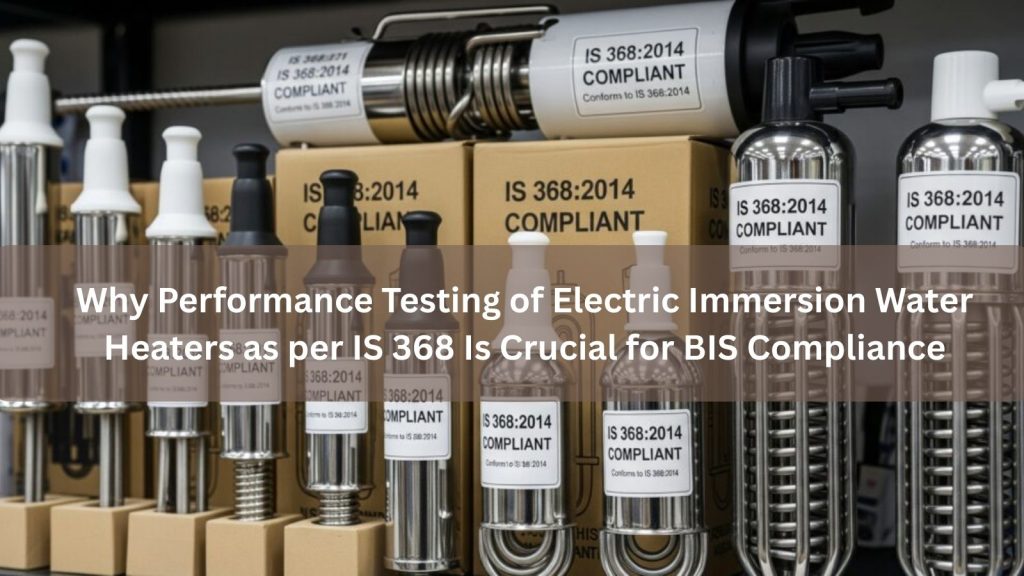
Electric immersion water heaters are widely used in households, laboratories, hostels, and industrial settings across India. Because these appliances operate on electricity and generate heat directly in water, their performance, safety, and efficiency must meet strict regulatory requirements. This is where IS 368:2014 + A1:1999 becomes critical.
Performance testing as per IS 368 is not just a formality—it is a mandatory step for BIS certification and market acceptance. In this article, we explain why electric immersion water heater testing under IS 368 is essential and how a certified laboratory plays a key role in compliance.
Understanding IS 368 for Electric Immersion Water Heaters
IS 368 is the Indian Standard that defines performance test requirements for electric immersion water heaters. The standard focuses on how efficiently and reliably the heater performs under defined operating conditions.
Unlike safety-only standards, IS 368 evaluates real-world performance parameters, ensuring that the product delivers the promised output without excessive energy consumption or operational failure.
Testing is conducted in a controlled electrical appliance testing laboratory, where accuracy and repeatability are ensured.
Why BIS Mandates Performance Testing Under IS 368
The Bureau of Indian Standards (BIS) requires manufacturers to prove that their immersion water heaters meet national benchmarks. Performance testing ensures:
- Consistent heating performance
- Acceptable energy consumption levels
- Product reliability during continuous use
- Compliance with Indian climatic and voltage conditions
Without testing from an IS 368 performance test laboratory, BIS certification cannot be granted.
Key Performance Parameters Evaluated During Testing
During immersion heater performance testing, laboratories assess several critical factors, including:
1. Heating Efficiency
The test verifies how effectively the heater converts electrical energy into heat. Poor efficiency leads to higher electricity bills and customer dissatisfaction.
2. Time to Temperature Rise
IS 368 specifies the allowable time required to raise water temperature to a defined level. This confirms the heater’s real-use performance.
3. Power Consumption
Actual power usage is measured and compared with the rated values declared by the manufacturer. Any major deviation can result in test failure.
4. Stability and Endurance
The heater is tested under continuous operation to ensure stable performance over time. Long-term reliability is a key expectation under IS 368.
Some test steps are performed under controlled conditions, but most evaluations rely on direct measurement and observation.
Role of an IS 368 Lab in Noida
Choosing the right laboratory is just as important as the product design itself. A BIS approved testing lab in Noida offers several advantages:
- Proximity to major manufacturing hubs
- Faster testing and reporting timelines
- Access to calibrated equipment and expert engineers
- Direct familiarity with BIS documentation processes
An accredited IS 368 lab in Noida ensures that test results are accepted without delays or rejections during BIS scrutiny.
Importance of Energy Efficiency Testing
Energy efficiency has become a major concern for both regulators and consumers. An energy efficiency testing lab in Noida evaluates whether the immersion heater minimizes energy loss while delivering effective heating.
Efficient products:
- Reduce electricity costs
- Support sustainability goals
- Enhance brand credibility
- Improve chances of BIS approval
Performance testing under IS 368 directly supports energy efficiency validation.
Why Manufacturers Cannot Skip Performance Testing
Skipping or underestimating electric water heater testing laboratory requirements can lead to serious consequences, such as:
- BIS certification rejection
- Product recalls
- Legal penalties
- Loss of market trust
Testing is not merely a regulatory checkbox—it is a quality assurance process that protects both manufacturers and end users.
How BIS-Approved Labs Add Value Beyond Compliance
A professional electrical appliance testing laboratory does more than just test products. It helps manufacturers:
- Identify performance gaps early
- Optimize heater design
- Reduce certification timelines
- Avoid costly re-testing
In many cases, performance issues are resolved during pre-compliance testing, saving time and money.
Conclusion
Performance testing of electric immersion water heaters as per IS 368 is a non-negotiable requirement for BIS compliance. It validates efficiency, reliability, and real-world usability of the product.
By working with a trusted IS 368 performance test laboratory—especially a BIS approved testing lab in Noida—manufacturers can ensure smooth certification, improved product quality, and long-term market success.