
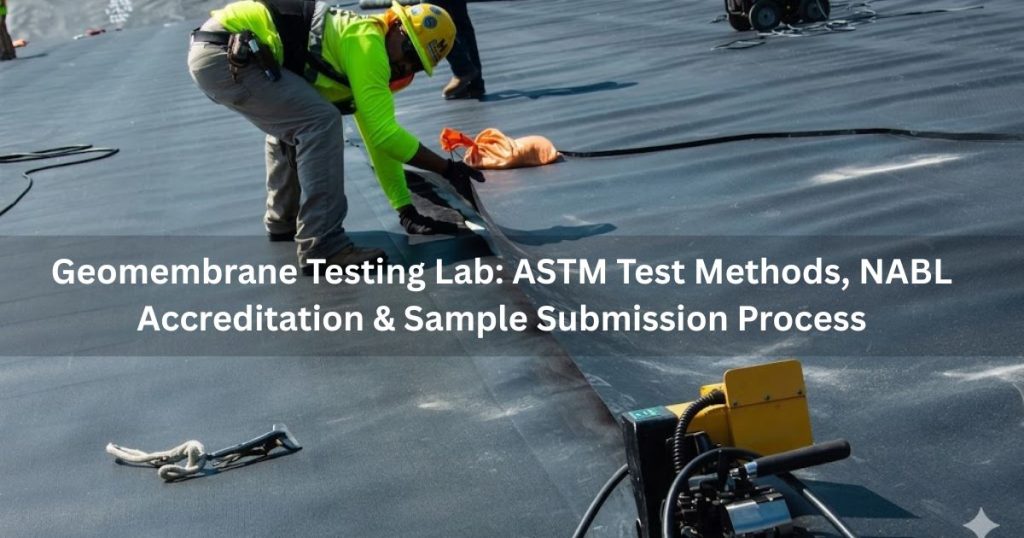
Geomembranes play a critical role in modern infrastructure, environmental protection, mining, water containment, landfill engineering, and industrial projects. These impermeable geosynthetic barriers prevent fluid migration and protect soil and groundwater from contamination. However, even the highest-quality geomembrane products require laboratory verification before installation and during quality assurance programs.
A reliable Geomembrane Testing Lab helps project owners, consultants, contractors, and manufacturers verify material performance according to international standards. Through advanced testing procedures, laboratories evaluate strength, durability, thickness, puncture resistance, seam integrity, and long-term environmental performance.
In India, the demand for Geomembrane Test India services has increased significantly due to growing investments in infrastructure, waste management, irrigation reservoirs, mining facilities, and environmental protection projects.
What is Geomembrane Testing?
Geomembrane testing is a systematic process used to assess the physical, mechanical, and durability properties of geomembrane materials. The objective is to ensure that the material meets project specifications and relevant ASTM standards before field deployment.
Testing helps determine:
- Material strength and durability
- Resistance to puncture and tearing
- Thickness consistency
- Seam welding quality
- Long-term oxidation resistance
- Environmental stress crack resistance
- Carbon black distribution quality
Proper Geosynthetic Testing reduces project risks, improves service life, and supports regulatory compliance.
Importance of Geomembrane Testing in India
India’s construction and environmental sectors increasingly depend on geosynthetic materials for critical containment applications. Poor-quality geomembranes can lead to leakage, environmental damage, project delays, and costly repairs.
A professional Geotech Lab Testing facility provides accurate test data that supports:
- Quality control during manufacturing
- Material acceptance before installation
- Compliance with ASTM specifications
- Third-party verification for project stakeholders
- Long-term asset protection
Testing becomes especially important for landfill liners, mining ponds, wastewater treatment plants, irrigation reservoirs, and industrial containment systems.
HDPE Geomembranes and Their Applications
Among various geomembrane materials, HDPE Geomembranes are the most widely used due to their excellent chemical resistance, durability, and cost-effectiveness.
Common applications include:
- Landfill liner systems
- Mining containment ponds
- Water reservoirs
- Canal lining projects
- Wastewater treatment plants
- Hazardous waste containment
- Industrial lagoons
- Aquaculture ponds
Because HDPE geomembranes often operate in demanding environments, laboratory testing is essential to verify their performance characteristics.
Key ASTM Test Methods for Geomembrane Testing
A qualified Geomembrane Testing Lab in India performs a range of ASTM tests to evaluate material quality and compliance.
ASTM D6693 – Tensile Properties
Purpose
ASTM D6693 determines the tensile strength and elongation characteristics of geomembranes.
Why It Matters
This test measures the material’s ability to withstand stretching forces without failure.
Key Parameters
- Yield strength
- Break strength
- Yield elongation
- Break elongation
Tensile properties are critical for evaluating the structural performance of HDPE geomembranes under field conditions.
ASTM D4833 – Puncture Resistance
Purpose
ASTM D4833 measures resistance to puncture from concentrated loads.
Why It Matters
Geomembranes often encounter sharp stones, construction equipment, and installation-related stresses.
Benefits
- Evaluates durability
- Predicts field performance
- Supports quality assurance programs
Higher puncture resistance contributes to longer service life.
ASTM D6392 – Seam Strength Evaluation
Purpose
ASTM D6392 assesses the strength of welded geomembrane seams.
Why It Matters
Most geomembrane failures occur at seam locations rather than within the sheet itself.
Evaluates
- Shear strength
- Peel strength
- Welding quality
Strong seam performance is essential for leak-free containment systems.
ASTM D5199 – Thickness Measurement
Purpose
ASTM D5199 determines geomembrane thickness with precision.
Why It Matters
Thickness directly influences durability, puncture resistance, and service life.
Importance
- Confirms manufacturing consistency
- Verifies specification compliance
- Supports quality control documentation
Thickness verification remains one of the most requested tests in Geomembrane Test India projects.
ASTM D5596 – Carbon Black Dispersion
Purpose
ASTM D5596 evaluates the distribution of carbon black particles within HDPE geomembranes.
Why It Matters
Proper carbon black dispersion improves UV resistance and long-term weathering performance.
Benefits
- Enhanced durability
- Improved environmental resistance
- Better service life prediction
Uniform carbon black distribution is essential for outdoor applications.
ASTM D3895 – Oxidative Induction Time (OIT)
Purpose
ASTM D3895 measures antioxidant depletion resistance.
Why It Matters
Antioxidants protect geomembranes from oxidation and premature degradation.
Significance
- Predicts long-term performance
- Evaluates aging resistance
- Supports durability assessment
OIT testing provides valuable information regarding expected service life.
ASTM D5397 – Stress Crack Resistance
Purpose
ASTM D5397 evaluates environmental stress crack resistance.
Why It Matters
Stress cracking represents one of the most critical long-term failure mechanisms in HDPE geomembranes.
Benefits
- Assesses durability
- Evaluates resistance to crack propagation
- Supports long-term performance predictions
High stress crack resistance ensures greater reliability in demanding environments.
NABL Accredited Geomembrane Testing Laboratory
Selecting a NABL-accredited Geomembrane Testing Lab provides confidence in test accuracy and reliability.
Advantages of NABL Accreditation
Technical Competence
Laboratories operate under internationally recognized quality systems.
Reliable Test Results
Calibration and quality control procedures ensure consistent measurements.
Regulatory Acceptance
Government agencies, consultants, and project owners widely accept NABL-accredited reports.
International Recognition
NABL accreditation aligns with ISO/IEC 17025 requirements.
For critical infrastructure projects, NABL accreditation is often a mandatory requirement.
Geosynthetic Testing Services Offered by Modern Laboratories
Comprehensive Geosynthetic Testing programs may include:
Geomembrane Testing
- Tensile strength
- Thickness
- Seam strength
- Puncture resistance
- OIT
- Stress crack resistance
Geotextile Testing
- Tensile properties
- Permeability
- Puncture resistance
- Mass per unit area
Geogrid Testing
- Tensile strength
- Junction efficiency
- Creep performance
GCL Testing
- Bentonite content
- Swell index
- Hydraulic conductivity
These services support infrastructure, environmental, transportation, and industrial projects.
Sample Submission Process for Geomembrane Testing
Submitting samples to a Geomembrane Testing Lab in India is a straightforward process.
Step 1: Contact the Laboratory
Share project details including:
- Material type
- Product grade
- Required ASTM tests
- Quantity of samples
Step 2: Receive Testing Requirements
The laboratory provides:
- Sample dimensions
- Packaging instructions
- Test schedule
- Quotation
Step 3: Dispatch Samples
Samples should be:
- Properly labeled
- Clean and undamaged
- Packed securely
Include purchase details and project information whenever possible.
Step 4: Laboratory Evaluation
Technicians conduct testing according to specified ASTM procedures using calibrated equipment.
Step 5: Receive Test Report
The final report typically includes:
- Test methodology
- Observed values
- Compliance assessment
- Laboratory authorization
These reports support quality assurance and project documentation.
How to Choose the Right Geomembrane Testing Lab
Before selecting a testing partner, evaluate:
Accreditation Status
Choose an NABL-accredited laboratory whenever possible.
ASTM Testing Capability
Verify availability of ASTM D6693, D4833, D6392, D5199, D5596, D3895, and D5397.
Technical Expertise
Experienced engineers and technicians improve testing reliability.
Turnaround Time
Faster reporting supports project schedules.
Industry Experience
A laboratory with extensive Geotech Lab Testing expertise understands project-specific requirements.
Why Professional Geomembrane Testing Matters
Independent testing provides confidence that materials will perform as expected throughout their service life. Verified results help reduce installation risks, avoid premature failures, and ensure regulatory compliance.
For manufacturers, testing strengthens product credibility. For contractors and project owners, it provides documented evidence of quality and performance.
Whether the project involves landfills, reservoirs, mining facilities, or industrial containment systems, comprehensive Geomembrane Testing, Geosynthetic Testing, and Geotech Lab Testing remain essential for long-term success.
Conclusion
The growing use of HDPE Geomembranes across India has increased the need for accurate and reliable laboratory testing. A qualified Geomembrane Testing Lab in India helps verify material quality through internationally recognized ASTM standards such as ASTM D6693, ASTM D4833, ASTM D6392, ASTM D5199, ASTM D5596, ASTM D3895, and ASTM D5397.
By choosing a NABL-accredited laboratory and following proper sample submission procedures, project stakeholders can ensure compliance, durability, and long-term performance. Investing in professional Geomembrane Test India services is not merely a quality-control requirement—it is a critical step toward protecting infrastructure, environmental resources, and project investments.