
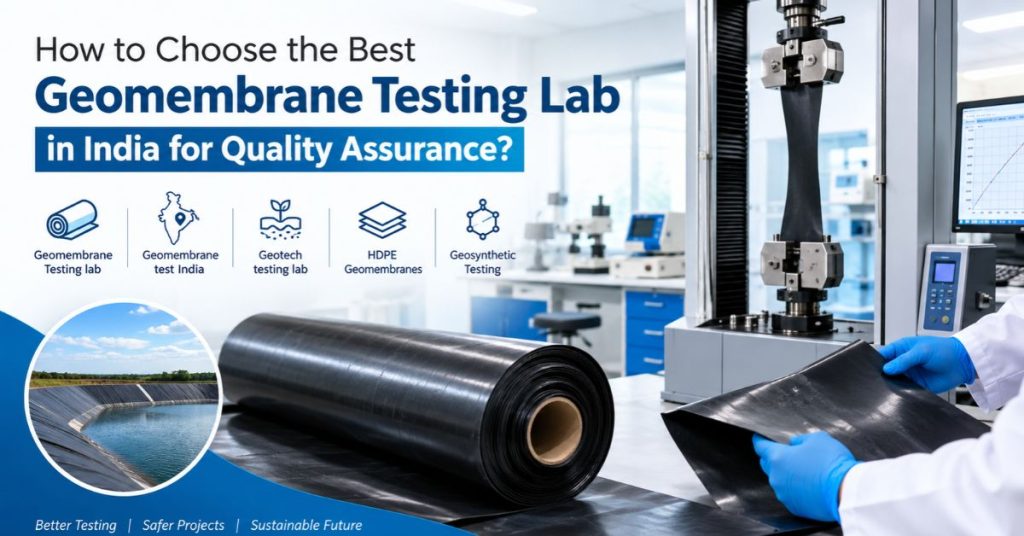
Geomembranes play an important role in modern infrastructure, environmental protection, and water management projects. These specialised materials create protective barriers that help prevent liquid leakage, soil contamination, and seepage. From landfill sites and reservoirs to canals, mining areas, and industrial storage facilities, HDPE Geomembranes support projects where long-term containment and durability matter.
However, selecting the right geomembrane material is only one part of the process. You also need to verify its quality, strength, flexibility, and performance before installation. This is where professional testing becomes important.
Choosing a reliable laboratory for Geomembrane test India services helps manufacturers, contractors, and project owners evaluate material quality against relevant technical requirements. A professional Geomembrane Testing lab can assess important physical and mechanical properties, identify material weaknesses, and provide test reports for quality assurance.
But how do you select the right testing laboratory? What tests should you consider? Which standards and laboratory capabilities matter?
This guide explains everything you need to know before selecting a geomembrane testing laboratory in India.
What Is Geomembrane Testing?
Geomembrane testing is the process of evaluating the physical, mechanical, and performance characteristics of geomembrane sheets used in construction, environmental, and industrial applications.
These sheets commonly consist of HDPE, LDPE, LLDPE, PVC, and other polymer-based materials. Each material offers different properties depending on its intended application.
Testing helps determine whether a geomembrane can withstand expected environmental conditions, installation stresses, and service requirements.
A professional laboratory may evaluate properties such as:
- Tensile strength and elongation
- Thickness and dimensional properties
- Puncture resistance
- Tear resistance
- Carbon black content and dispersion
- Oxidative induction time (OIT)
- Density and other material properties
- Environmental stress crack resistance, where applicable
The required tests depend on the material type, applicable specifications, product standards, and project requirements.
Why Is Geomembrane Testing Important for Quality Assurance?
Geomembranes often work as protective barriers in projects where leakage or material failure can create significant problems. Even a small defect in the material can affect the performance of an entire installation.
Here are some important reasons to conduct proper geomembrane testing.
1. Ensures Material Strength and Durability
Geomembranes must withstand handling, transportation, installation, and service conditions. Tensile, tear, and puncture resistance tests help assess their mechanical performance.
2. Helps Prevent Leakage and Environmental Contamination
Landfills, wastewater treatment facilities, and industrial containment areas depend on effective barrier systems. Testing helps evaluate whether the selected material meets the specified quality requirements.
3. Verifies Compliance with Technical Standards
Different applications require different testing parameters and acceptance criteria. Laboratory testing helps manufacturers and project teams check materials against relevant IS, ASTM, ISO, or project-specific specifications.
4. Supports Better Material Selection
Not every geomembrane suits every application. Testing results help buyers compare material properties and choose products that meet their technical and operational requirements.
5. Improves Project Quality Control
Regular material testing supports quality checks during manufacturing, procurement, and project execution. It also helps maintain documentation for inspection and quality assurance.
How to Choose the Best Geomembrane Testing Lab in India?
Finding a laboratory is easy, but selecting one with the right technical capabilities requires careful evaluation.
If you are searching for reliable Geomembrane test India services, consider the following factors before making your decision.
1. Check NABL Accreditation and Testing Scope
One of the first things to check is whether the laboratory holds NABL accreditation under ISO/IEC 17025 for the relevant testing parameters.
However, accreditation alone is not enough. You should verify whether the specific geomembrane tests you require are included in the laboratory’s current accredited scope.
Check the following:
- Valid accreditation status
- Applicable testing parameters
- Relevant test methods and standards
- Material categories covered under the scope
- Validity and scope documentation
This step helps you identify a laboratory with suitable technical competence for your testing requirements.
2. Evaluate Available Testing Facilities
A reliable Geomembrane Testing lab should have suitable equipment and trained technical personnel to perform the required tests.
Depending on the requested testing scope, facilities may include:
- Universal Testing Machine (UTM)
- Thickness measurement instruments
- Puncture resistance testing equipment
- Tear resistance testing arrangements
- Carbon black content testing facilities
- Thermal analysis equipment for OIT testing
- Density measurement equipment
Before submitting samples, ask the laboratory which tests it can perform and whether the required methods are available.
3. Verify Knowledge of HDPE Geomembranes
HDPE Geomembranes are widely used in landfill liners, water reservoirs, mining operations, canals, and other containment applications.
These materials require careful evaluation because different properties affect their suitability for specific applications.
Important parameters may include tensile properties, thickness, puncture resistance, carbon black content, carbon black dispersion, and oxidative resistance.
Choose a laboratory that understands the testing requirements of HDPE geomembranes and can guide you towards the appropriate test methods.
4. Check Applicable IS, ASTM and ISO Standards
Testing standards help establish consistent procedures for evaluating geomembrane properties.
Depending on the product and application, relevant standards may include:
- ASTM D6693 – Tensile Properties of Nonreinforced Polyethylene and Flexible Polypropylene Geomembranes.
- ASTM D4833 – Index Puncture Resistance of Geomembranes and Related Products.
- ASTM D1004 – Tear Resistance of Plastic Film and Sheeting.
- ASTM D5199 – Measuring the Nominal Thickness of Geosynthetics.
- ASTM D1603 – Carbon Black Content in Olefin Plastics.
- ASTM D3895 – Oxidative-Induction Time of Polyolefins by DSC.
- ASTM D5397 – Evaluation of Stress Crack Resistance of Polyolefin Geomembranes.
Always confirm the current edition and applicability of each standard before testing. The correct method depends on the material, product specification, and intended application.
5. Review Technical Experience and Testing Reports
A laboratory’s technical experience can make a significant difference in the testing process.
Before choosing a service provider, ask about its experience with polymer sheets, HDPE geomembranes, and other geosynthetic materials.
You should also review sample test reports to understand how the laboratory presents its findings.
A useful test report generally includes:
- Sample identification details
- Test method and applicable standard
- Testing conditions
- Observed results
- Units of measurement
- Acceptance criteria, where provided
- Relevant accreditation status
Clear reporting helps engineers, manufacturers, and quality control teams make informed decisions.
6. Compare Turnaround Time and Customer Support
Project schedules often depend on timely material testing. Delays in receiving reports can affect procurement, installation, and quality approval.
Ask the laboratory about sample submission procedures, estimated turnaround time, testing availability, and report delivery.
A professional testing partner should also communicate clearly if additional sample quantities or information are required.
7. Consider Technical Guidance and Transparency
The best laboratory is not n ecessarily the one offering the lowest price. Look for a testing partner that explains the required parameters, applicable methods, and limitations clearly.
Before confirming your order, ask for a quotation with a clear breakdown of:
- Required tests
- Applicable standards
- Sample quantity
- Testing charges
- Estimated completion time
- Report format
This makes it easier to compare laboratories and avoid unexpected costs.
Important Tests Performed on HDPE Geomembranes
If you are planning Geosynthetic Testing, understanding the major testing parameters can help you select the right laboratory and testing package.
Here are some commonly requested tests for HDPE geomembranes.
1. Tensile Strength Test
This test evaluates how a geomembrane responds when subjected to a pulling force.
It helps determine tensile strength and elongation properties, which are important for understanding material behaviour during installation and service.
2. Puncture Resistance Test
Geomembranes may come into contact with stones, sharp objects, uneven surfaces, or other materials during installation.
Puncture resistance testing evaluates the material’s ability to withstand a concentrated force without being penetrated.
3. Thickness Test
Thickness is an important property that influences material specifications and quality consistency.
The test measures the geomembrane thickness at specified locations using an appropriate measurement method.
4. Tear Resistance Test
Tear resistance testing evaluates how the material responds when a tear begins or continues under an applied force.
This information helps assess the mechanical performance of geomembrane sheets.
5. Carbon Black Content Test
Carbon black is commonly added to HDPE geomembranes to improve resistance to ultraviolet radiation.
This test determines the amount of carbon black present in the material and helps evaluate compliance with the specified requirements.
6. Carbon Black Dispersion Test
The test evaluates how uniformly carbon black particles are distributed throughout the polymer material.
Proper dispersion is important for consistent material performance.
7. Oxidative Induction Time (OIT) Test
OIT testing evaluates the oxidative stability of polyolefin materials under specified laboratory conditions.
It helps assess the effectiveness of the antioxidant system used in HDPE geomembranes.
8. Environmental Stress Crack Resistance Test
This test evaluates the resistance of a polymer material to stress cracking under specified environmental and testing conditions.
It can be particularly important when evaluating HDPE geomembranes intended for demanding applications.
Applications of Geomembranes in Different Industries
Geomembranes serve several important purposes across construction, environmental protection, and industrial projects.
Some common applications include:
1. Landfill Projects: Geomembranes act as liner systems to help control leachate migration and protect surrounding soil and groundwater.
2. Water Reservoirs: They help reduce seepage and support water storage in reservoirs, ponds, and irrigation facilities.
3. Mining Industry: Geomembranes are used in containment systems, tailings facilities, and heap leach pads.
4. Wastewater Treatment Plants: They help provide containment barriers in treatment ponds and storage facilities.
5. Canal and Irrigation Projects: Geomembrane liners help reduce water loss through seepage.
6. Industrial Applications: They support liquid containment and other protective barrier requirements in industrial facilities.
The appropriate geomembrane type and testing requirements depend on the project’s design, operating conditions, and applicable specifications.
Why Choose a Professional Geomembrane Testing Lab in India?
Choosing a technically capable laboratory helps ensure that your material receives the appropriate evaluation before use.
A professional testing laboratory can support:
- Manufacturers looking to verify product quality.
- Contractors requiring material testing before installation.
- Infrastructure developers managing large construction projects.
- Quality control teams checking product specifications.
- Suppliers and importers seeking independent test reports.
- Consultants requiring technical test data for project documentation.
If your project involves HDPE geomembranes or other geosynthetic materials, selecting the right testing partner can make quality verification more systematic and reliable.
Geomembrane Testing Services at Stellar Test House
Stellar Test House provides testing and inspection services across various industrial and construction-related sectors.
If you require Geomembrane Testing lab services in India, you can contact Stellar Test House to discuss your material type, required testing parameters, and applicable standards.
The laboratory team can help you understand the testing requirements and guide you regarding sample submission and service availability.
Why Contact Stellar Test House?
- Testing support for industrial and construction-related materials.
- Technical assistance regarding applicable testing requirements.
- Support for quality evaluation and material verification.
- Testing and reporting based on the agreed scope and applicable methods.
- Convenient coordination for testing enquiries.
For specific geomembrane parameters, accreditation coverage, and test availability, contact the laboratory directly for confirmation.
Frequently Asked Questions (FAQs)
1. What is a geomembrane testing lab?
A geomembrane testing lab evaluates the physical, mechanical, and other specified properties of geomembrane materials. It helps manufacturers and project owners verify whether materials meet relevant quality requirements.
2. Why is HDPE geomembrane testing important?
HDPE geomembrane testing helps assess important properties such as tensile strength, puncture resistance, thickness, carbon black content, and oxidative stability. These results support material selection and quality control.
3. Where can I find a Geomembrane test India service provider?
You can search for laboratories offering geomembrane and geosynthetic material testing services. Before selecting one, verify its relevant NABL accreditation scope, available test methods, technical facilities, and reporting process.
4. Which standards are used for geomembrane testing?
Commonly referenced standards include ASTM D6693, ASTM D4833, ASTM D5199, ASTM D1603, ASTM D3895, and other applicable methods. The correct standard depends on the material and required parameter.
5. What is the difference between geomembranes and geosynthetics?
Geosynthetics are a broad category of synthetic materials used in civil engineering and infrastructure projects. Geomembranes are one type of geosynthetic material, mainly used as low-permeability barriers.
6. How much does geomembrane testing cost in India?
The cost depends on the number of tests, material type, applicable standards, sample requirements, and laboratory facilities. Contact the testing laboratory with your required parameters to obtain an accurate quotation.
7. Which tests are important for HDPE geomembranes?
Common tests include tensile properties, puncture resistance, thickness, tear resistance, carbon black content, carbon black dispersion, OIT, and environmental stress crack resistance, depending on the product specification.
8. Can a geotech testing lab perform geomembrane testing?
Some geotechnical laboratories offer geosynthetic and geomembrane testing facilities, while others focus mainly on soil and construction materials. Always confirm the specific testing capability and relevant accreditation scope before submitting samples.
Conclusion
Choosing the right laboratory for geomembrane testing is an important step towards maintaining material quality and project reliability. From tensile strength and puncture resistance to carbon black content and oxidative stability, each testing parameter provides useful information about geomembrane performance.
Before selecting a Geomembrane Testing lab, check its accreditation scope, technical facilities, applicable testing standards, reporting quality, and customer support.
Whether you are a manufacturer, contractor, supplier, or infrastructure developer, proper Geosynthetic Testing can help you make informed decisions about HDPE geomembranes and other polymer-based materials.
Looking for reliable Geomembrane test India services?
Contact Stellar Test House to discuss your geomembrane testing requirements, confirm available testing parameters, and request a quotation for your project.
Stellar Test House
G-68, G-Block, Sector 63, Noida, Uttar Pradesh – 201301
Website: https://stellartesthouse.com/
Email: [email protected]
Get in touch with our team to discuss your testing requirements and quality assurance needs.
Frequently Asked Questions (FAQs)
1. What is a geomembrane testing lab?
A geomembrane testing lab evaluates the physical, mechanical, and other specified properties of geomembrane materials. It helps manufacturers and project owners verify whether materials meet relevant quality requirements.
2. Why is HDPE geomembrane testing important?
HDPE geomembrane testing helps assess important properties such as tensile strength, puncture resistance, thickness, carbon black content, and oxidative stability. These results support material selection and quality control.
3. Where can I find a Geomembrane test India service provider?
You can search for laboratories offering geomembrane and geosynthetic material testing services. Before selecting one, verify its relevant NABL accreditation scope, available test methods, technical facilities, and reporting process.
4. Which standards are used for geomembrane testing?
Commonly referenced standards include ASTM D6693, ASTM D4833, ASTM D5199, ASTM D1603, ASTM D3895, and other applicable methods. The correct standard depends on the material and required parameter.
5. What is the difference between geomembranes and geosynthetics?
Geosynthetics are a broad category of synthetic materials used in civil engineering and infrastructure projects. Geomembranes are one type of geosynthetic material, mainly used as low-permeability barriers.
6. How much does geomembrane testing cost in India?
The cost depends on the number of tests, material type, applicable standards, sample requirements, and laboratory facilities. Contact the testing laboratory with your required parameters to obtain an accurate quotation.
7. Which tests are important for HDPE geomembranes?
Common tests include tensile properties, puncture resistance, thickness, tear resistance, carbon black content, carbon black dispersion, OIT, and environmental stress crack resistance, depending on the product specification.
8. Can a geotech testing lab perform geomembrane testing?
Some geotechnical laboratories offer geosynthetic and geomembrane testing facilities, while others focus mainly on soil and construction materials. Always confirm the specific testing capability and relevant accreditation scope before submitting samples.