
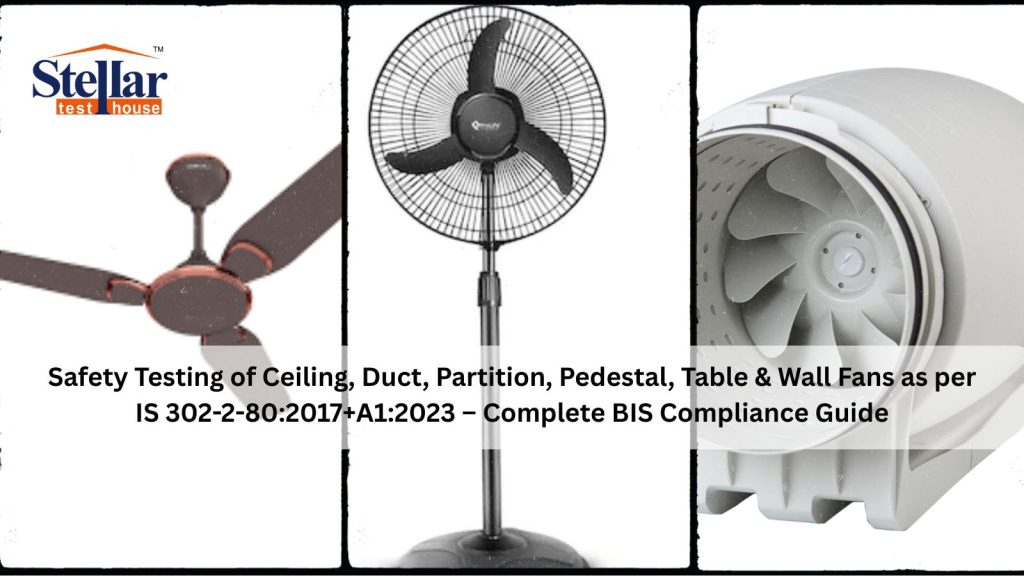
Electric fans remain one of the most widely used household and industrial electrical appliances in India. From ceiling fans in homes to duct fans in commercial buildings, safety is not optional—it is mandatory. To ensure user protection and product reliability, the Bureau of Indian Standards (BIS) mandates safety evaluation under IS 302-2-80:2017+A1:2023.
This guide explains the IS 302-2-80 fan safety test, its scope, testing requirements, and how manufacturers can achieve BIS compliance for all major fan categories.
Understanding IS 302-2-80:2017+A1:2023
IS 302-2-80 is part of the IS 302 series, aligned with IEC 60335 standards. This specific standard focuses on safety requirements for electric fans, covering electrical, mechanical, thermal, and fire hazards.
Any manufacturer or importer applying for ISI testing for electric fans must comply with this standard before placing products in the Indian market.
Why Fan Safety Testing Is Mandatory in India
Electric fans operate for long hours and often in close proximity to users. Without proper safety validation, risks such as electric shock, overheating, insulation failure, or mechanical injury may arise.
BIS safety testing ensures that:
- Products meet national safety benchmarks
- Consumers remain protected during normal and abnormal usage
- Manufacturers avoid legal and financial risks
- ISI marking approval proceeds without delays
Types of Fans Covered Under IS 302-2-80
This standard applies to a wide range of electric fans used in domestic, commercial, and industrial environments.
1. Ceiling Fans
Ceiling fans are subject to strict mechanical and electrical checks due to overhead installation and continuous operation.
The ceiling fan safety test IS 302-2-80 evaluates insulation strength, input power, heating, and resistance to moisture.
Manufacturers often prefer a certified ceiling fan testing laboratory in India to ensure accurate and BIS-recognized results.
2. Duct Fans
Duct fans are commonly used in HVAC and ventilation systems.
Duct fan safety testing focuses on:
- Motor temperature rise
- Protection against access to live parts
- Stability during continuous operation
- Abnormal operation conditions
3. Partition Fans
Partition fans, used in offices and industrial spaces, require precise mechanical safety evaluation.
A partition fan safety test in India verifies blade strength, enclosure safety, and electrical insulation under operational stress.
4. Pedestal Fans
Pedestal fans combine mobility with power, making stability testing critical.
The standard examines tipping resistance, overheating, cord anchorage, and earthing continuity.
5. Table Fans
Table fans are widely used in homes, making BIS compliance essential.
A certified table fan ISI testing laboratory conducts tests for blade protection, electrical leakage, and endurance performance.
6. Wall Fans
Wall fans must remain secure during long-term operation.
Manufacturers often seek wall fan safety testing in Noida, where accredited labs conduct mounting strength, vibration, and heating tests as per IS 302-2-80.
Key Tests Conducted Under IS 302-2-80
An electric fan safety testing laboratory performs a detailed evaluation that includes:
- Protection against electric shock
- Input power and current measurement
- Temperature rise test
- Insulation resistance and dielectric strength
- Mechanical strength and blade impact test
- Stability and mounting test
- Abnormal operation test
Each fan safety test as per IS 302-2-80 follows controlled conditions and calibrated instruments to ensure reliable results.
Role of an Accredited Testing Laboratory
Choosing the right laboratory plays a crucial role in BIS approval. An experienced lab ensures:
- Accurate interpretation of IS 302-2-80 requirements
- Proper test sequencing
- BIS-acceptable test reports
- Reduced certification timelines
Manufacturers targeting faster approval often collaborate with a BIS-recognized electric fan safety testing laboratory that understands compliance documentation and audit expectations.
ISI Certification Process for Electric Fans
The ISI testing for electric fans generally involves:
- Product sample submission
- Safety testing as per IS 302-2-80
- Factory inspection by BIS
- Review of test reports
- Grant of ISI license
Compliance at the testing stage significantly improves approval success.
Common Reasons for Test Failure
Many products fail due to avoidable issues such as:
- Poor insulation material
- Excessive temperature rise
- Inadequate earthing
- Weak blade or guard construction
Early pre-testing at a qualified lab helps identify and resolve these issues before BIS submission.
Why IS 302-2-80 Compliance Builds Market Trust
Beyond certification, compliance demonstrates product quality and responsibility. Retailers, government buyers, and institutional clients increasingly demand ISI-marked fans.
Safety-certified products experience:
- Higher consumer confidence
- Fewer warranty claims
- Better brand reputation
- Easier market expansion
Conclusion
Compliance with IS 302-2-80:2017+A1:2023 is not just a regulatory requirement—it is a commitment to safety, quality, and reliability. Whether you manufacture ceiling fans, duct fans, partition fans, pedestal fans, table fans, or wall fans, timely and accurate safety testing ensures smooth BIS certification and long-term market success.
Partnering with a competent testing laboratory simplifies the journey from product development to ISI approval while ensuring complete compliance with Indian safety standards.
Frequently Asked Questions (FAQs) – Fan Safety Testing as per IS 302-2-80
1. What is IS 302-2-80 fan safety test?
The IS 302-2-80 fan safety test is a mandatory safety evaluation prescribed by the Bureau of Indian Standards (BIS) for electric fans. It checks electrical, mechanical, and thermal safety to ensure that fans operate safely under normal and abnormal conditions without causing electric shock, fire, or mechanical injury.
2. Is ISI certification mandatory for electric fans in India?
Yes, ISI testing for electric fans is mandatory in India for manufacturers and importers. Without ISI marking, electric fans cannot be legally sold in the Indian market. BIS grants the ISI license only after successful safety testing as per IS 302-2-80.
3. Which types of fans are covered under IS 302-2-80?
IS 302-2-80 applies to a wide range of electric fans, including:
- Ceiling fans
- Duct fans
- Partition fans
- Pedestal fans
- Table fans
- Wall fans
Each category undergoes specific safety checks based on its design and usage.
4. What tests are conducted during ceiling fan safety testing?
The ceiling fan safety test IS 302-2-80 includes insulation resistance, dielectric strength, temperature rise, blade strength, mechanical stability, and abnormal operation tests. These tests ensure the fan remains safe during continuous overhead operation.
5. Where can manufacturers get ceiling fan testing done in India?
Manufacturers can approach a BIS-recognized ceiling fan testing laboratory in India that is equipped to conduct all required tests as per IS 302-2-80 and provide BIS-acceptable test reports.
6. What is included in duct fan safety testing?
Duct fan safety testing focuses on motor heating, electrical insulation, protection against access to live parts, and performance under abnormal operating conditions. These tests are especially important for HVAC and industrial ventilation applications.
7. Is partition fan safety testing required for office-use fans?
Yes. A partition fan safety test in India is required for office and industrial partition fans. BIS evaluates mechanical strength, enclosure safety, earthing continuity, and electrical insulation before granting ISI approval.
8. How is table fan ISI testing conducted?
At a certified table fan ISI testing laboratory, the fan undergoes blade guard checks, leakage current tests, temperature rise tests, and stability evaluation. These tests ensure safe usage in domestic environments.
9. Why is wall fan safety testing important?
Wall fans operate for extended periods and remain fixed at height. Wall fan safety testing in Noida or other BIS-recognized locations ensures secure mounting, vibration control, electrical safety, and long-term reliability.
10. How long does IS 302-2-80 testing take?
The testing duration depends on the fan type and sample readiness. Typically, safety testing takes 7–15 working days, followed by BIS documentation and factory inspection.
11. Can one test report be used for multiple fan models?
In some cases, BIS allows grouping of similar models. However, variations in motor rating, blade size, or construction may require separate testing. A qualified electric fan safety testing laboratory can guide manufacturers on model grouping.
12. What are the common reasons for failure in fan safety tests?
Common failures include excessive temperature rise, poor insulation, inadequate earthing, and weak mechanical construction. Pre-compliance testing helps identify these issues early.
13. Why should manufacturers choose a professional safety testing laboratory?
A professional electric fan safety testing laboratory ensures accurate testing, BIS-compliant reports, reduced certification delays, and expert guidance throughout the ISI approval process.
14. Does IS 302-2-80 align with international standards?
Yes. IS 302-2-80 is technically aligned with IEC 60335, making compliance beneficial for both domestic sales and international quality acceptance.
15. How does ISI certification benefit fan manufacturers?
ISI certification builds consumer trust, improves market acceptance, reduces liability risks, and ensures smooth entry into government and institutional procurement channels.