
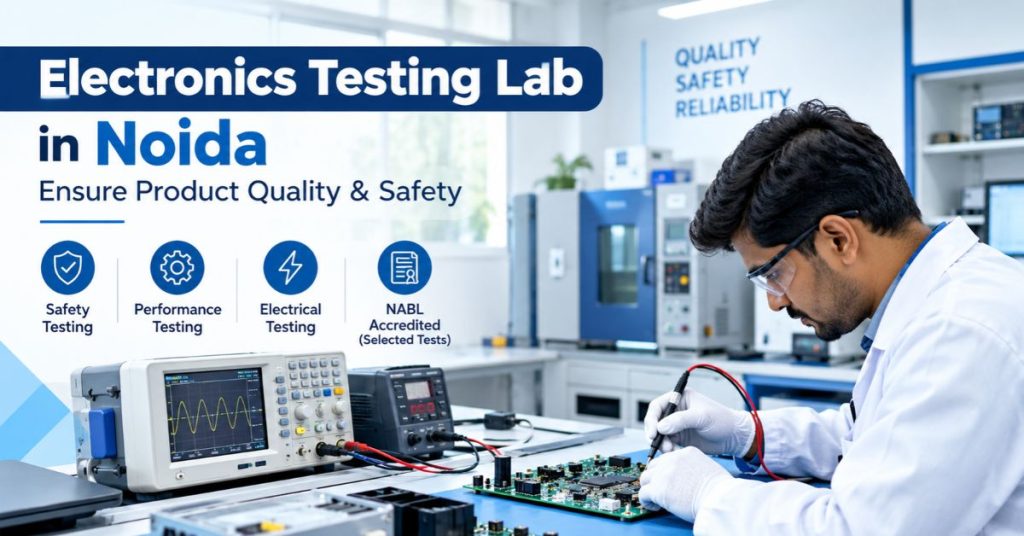
Electronic products play an important role in our daily lives, from household appliances and electrical equipment to industrial machines and electronic components. However, before manufacturers introduce these products to the market, they need to ensure that every product meets the required quality, safety and performance standards.
This is where an Electronics Testing Lab becomes important. Professional testing helps manufacturers identify product defects, evaluate electrical safety, check performance and improve product reliability before products reach customers.
If you are a manufacturer, importer, supplier or product developer looking for a reliable testing facility, choosing the right laboratory can make a significant difference. But with several testing laboratories available, how do you identify the right one?
In this guide, we will explain how to choose the best Electronics Testing Lab in Noida, which testing services to consider, why laboratory accreditation matters and what you should check before submitting your products for testing.
What Is an Electronics Testing Lab?
An Electronics Testing Lab is a specialized facility that evaluates electronic products, components and equipment to check their quality, safety, functionality and performance.
These laboratories use suitable testing equipment, established procedures and applicable national or international standards to assess whether a product meets its intended requirements.
Depending on the product category, electronic testing may include:
- Electrical safety testing
- Performance and functional testing
- Temperature and environmental testing
- Insulation resistance testing
- Power consumption testing
- Durability and reliability testing
- Electromagnetic compatibility (EMC) testing, where applicable
For manufacturers, testing provides useful technical information about product performance and helps identify potential issues before commercial distribution.
Why Is Choosing the Right Electronics Testing Lab Important?
Not every testing laboratory offers the same capabilities. Some specialize in electrical safety, while others focus on electronic equipment, environmental conditions or specific product categories.
Choosing an experienced Electronics and Electrical Testing Lab offers several advantages.
1. Ensures Product Safety
Electrical and electronic products can create safety risks if they contain design defects, insulation failures or improper electrical connections.
A professional laboratory evaluates relevant safety parameters to help identify potential hazards and improve product safety.
2. Improves Product Quality
Testing helps manufacturers identify performance-related issues, manufacturing defects and inconsistencies. Based on the test results, companies can make necessary improvements before releasing their products.
3. Supports Regulatory Compliance
Different electronic products may need to comply with specific Indian or international standards, depending on their category and intended use.
A competent laboratory can help identify applicable testing requirements and conduct tests within its approved scope.
4. Builds Customer Confidence
Customers expect electronic products to work safely and consistently. Reliable test reports provide technical evidence of evaluated product characteristics and help manufacturers demonstrate their commitment to quality.
5. Reduces Product Failure Risks
Testing products during development and before market launch helps manufacturers detect problems early. This can reduce product returns, warranty claims and unexpected maintenance expenses.
How to Choose the Best Electronics Testing Lab in Noida?
Selecting a testing laboratory requires more than comparing prices. You should evaluate its accreditation, technical capabilities, testing facilities, experience and reporting process.
Here are the most important factors to consider.
1. Check NABL Accreditation and Testing Scope
One of the first things to verify is whether the laboratory holds NABL accreditation under ISO/IEC 17025:2017.
However, accreditation alone is not enough. You should also check whether the specific testing method and product category fall within the laboratory’s approved scope.
For example, a laboratory may hold NABL accreditation but may not have accreditation for every electrical or electronic test you require.
Always verify the current accreditation certificate and scope before submitting your product.
2. Evaluate Available Testing Facilities
A reliable Electronics Testing Lab should have suitable instruments, equipment and technical facilities for the tests it offers.
Depending on your product requirements, check whether the laboratory can perform:
- Electrical safety evaluation
- Voltage and current measurements
- Insulation resistance testing
- Power and energy consumption testing
- Temperature rise assessment
- Functional performance testing
- Environmental testing
- EMC testing, if included in its scope
The availability of appropriate equipment helps ensure that the laboratory can perform the required evaluation using suitable test methods.
3. Check Experience in Your Product Category
Different electronic products require different testing approaches.
For example, a ceiling fan, mixer grinder, power supply, electrical switch and electronic control unit do not have identical testing requirements.
Before selecting an Electrical Testing Lab, explain your product category and testing objectives. Ask whether the laboratory has experience with similar products and the relevant standards.
This will help you avoid unnecessary tests and identify the right testing requirements.
4. Understand Applicable IS and International Standards
Product testing should follow the relevant standards and technical requirements.
In India, different electronic and electrical products may fall under applicable BIS standards, quality control orders or other regulatory requirements.
Depending on the product, relevant standards may include:
- IS standards for electrical appliances and equipment
- IEC standards for electrical and electronic safety
- EMC-related standards, where applicable
- Product-specific performance and environmental standards
Do not assume that one standard applies to every electronic product. Confirm the latest applicable standard and testing requirements before proceeding.
5. Compare Testing Charges and Turnaround Time
Testing costs depend on several factors, including product type, number of samples, test parameters, applicable standards and testing complexity.
Before confirming your testing request, ask the laboratory for:
- A detailed quotation
- Required sample quantity
- Testing parameters
- Estimated completion time
- Additional charges, if any
- Test report delivery details
Avoid selecting a laboratory only because it offers the lowest price. Technical capability, accurate results and relevant accreditation should remain your priorities.
6. Review Test Reports and Technical Support
A professional laboratory should provide clear and properly documented test reports.
Before choosing a testing partner, understand whether its reports include:
- Product identification details
- Testing methods and applicable standards
- Parameters evaluated
- Test observations and results
- Relevant acceptance criteria
- Authorized approval and report identification
You should also be able to discuss technical queries with the laboratory team when clarification is required.
What Tests Are Commonly Performed in an Electronics and Electrical Testing Lab?
Testing requirements depend on the product design, application and applicable standards. Some commonly requested evaluations include the following.
Electrical Safety Testing
Electrical safety testing checks important parameters associated with safe product operation. Depending on the applicable standard, evaluations may include insulation resistance, dielectric strength, leakage current and protective earthing.
Performance Testing
Performance testing evaluates whether an electronic product operates according to its intended specifications.
For example, a household electrical appliance may undergo functional checks, power consumption measurements and operational performance assessments.
Temperature Rise Testing
Temperature rise testing evaluates how much heat a product generates during operation under specified conditions.
It helps identify excessive heating that could affect product performance, component life or safety.
Insulation Resistance Testing
This test evaluates the electrical resistance of insulating materials between specified conductive parts.
It helps identify insulation-related issues that may affect electrical safety.
Environmental Testing
Electronic products may operate in different environmental conditions. Depending on the intended application, testing can evaluate their response to temperature, humidity and other environmental stresses.
Electromagnetic Compatibility Testing
EMC testing evaluates electromagnetic emissions and immunity characteristics of electronic equipment according to applicable requirements.
It helps assess whether equipment can operate without causing unacceptable electromagnetic interference or being unduly affected by external electromagnetic disturbances.
Important: Not every laboratory performs all these tests. Always confirm the availability of the required testing facility and its accreditation scope.
Documents and Information Required for Electronics Product Testing
Preparing the correct information before contacting a laboratory can make the testing process smoother.
Generally, manufacturers may need to provide:
- Product name and model number.
- Manufacturer or brand details.
- Product technical specifications.
- Electrical ratings, such as voltage, frequency and power.
- Product drawings or circuit diagrams, if required.
- Applicable IS or IEC standard, if already identified.
- Required testing parameters.
- Product samples in the specified quantity.
The exact documentation depends on the product category and testing requirements. Contact the laboratory before sending samples to confirm the necessary details.
Why Choose Stellar Test House for Electronics and Electrical Testing?
When selecting a testing partner in Noida, manufacturers should look for technical expertise, suitable testing facilities and a commitment to reliable laboratory practices.
Stellar Test House is a testing laboratory based in Sector 63, Noida, providing testing services across multiple product and material categories.
With its focus on quality evaluation and technical testing, Stellar Test House supports manufacturers, suppliers and businesses looking to assess product quality and meet applicable testing requirements.
Why Consider Stellar Test House?
- Established testing laboratory with experience across multiple testing categories.
- ISO/IEC 17025:2017-based laboratory quality framework.
- NABL accreditation, subject to the applicable and current approved testing scope.
- Testing services for different industrial and commercial requirements.
- Technical support for understanding product testing requirements.
- Convenient location in Sector 63, Noida.
Before booking, customers can discuss their product category, applicable standards and required testing parameters with the laboratory team.
Who Needs Electronics Testing Services?
Electronics and electrical testing services can benefit several types of businesses, including:
- Electronic product manufacturers
- Electrical equipment manufacturers
- Household appliance manufacturers
- Importers and distributors
- Industrial equipment suppliers
- Product developers and OEM companies
- Businesses involved in product quality assurance
Whether you are launching a new product or checking an existing product’s performance, appropriate laboratory testing can support better quality control.
How to Book an Electronics Testing Service in Noida?
Getting started with product testing is straightforward when you have the necessary product information.
Step 1: Share Product Details
Contact the laboratory and provide your product name, model, technical specifications and intended application.
Step 2: Discuss Testing Requirements
Explain which parameters you want to evaluate. The technical team can help identify relevant testing requirements based on the product and applicable standards.
Step 3: Submit Product Samples
Arrange the required samples and documentation according to the laboratory’s instructions.
Step 4: Complete the Testing Process
The laboratory performs the agreed tests using applicable methods and procedures.
Step 5: Receive the Test Report
After completing the testing process, the laboratory issues the relevant test report with recorded observations and results.
Contact Stellar Test House for Testing Requirements
Choosing the right Electronics Testing Lab is an important step towards improving product quality, evaluating safety and building customer confidence.
If you are a manufacturer, supplier or business looking for an Electronics and Electrical Testing Lab in Noida, connect with Stellar Test House to discuss your product testing requirements.
Get in touch with the technical team to understand the available testing services, applicable standards, sample requirements and estimated testing charges.
Stellar Test House
- Address: G-68, G-Block, Sector 63, Noida, Uttar Pradesh – 201301
- Website: https://stellartesthouse.com/
- Email: [email protected]
Contact Stellar Test House today to discuss your electronics and electrical product testing requirements.
Frequently Asked Questions (FAQs)
1. What does an Electronics Testing Lab do?
An Electronics Testing Lab evaluates electronic products and equipment for relevant safety, performance, functionality and quality parameters using suitable testing methods and standards.
2. How do I choose the best Electronics Testing Lab in Noida?
Check NABL accreditation and its specific testing scope, technical facilities, experience, applicable standards, report quality, turnaround time and testing charges before selecting a laboratory.
3. Is NABL accreditation important for electronics testing?
Yes. NABL accreditation under ISO/IEC 17025:2017 provides recognition of a laboratory’s technical competence for the specific tests included in its approved scope. Always verify the current certificate and scope.
4. What products can be tested in an Electronics and Electrical Testing Lab?
Depending on the laboratory’s capabilities, testing may cover household appliances, electrical equipment, electronic components, power supplies, industrial electrical products and other electronic devices.
5. How much does electronics product testing cost in Noida?
The cost depends on the product category, testing parameters, applicable standards, sample requirements and complexity. Contact the laboratory for a product-specific quotation.
6. How long does electronics testing take?
Testing time varies according to the product, number of tests, testing procedures and laboratory workload. The laboratory can provide an estimated timeline after reviewing your requirements.
7. What is the difference between an Electrical Testing Lab and an Electronics Testing Lab?
An Electrical Testing Lab generally focuses on electrical equipment, electrical safety and related performance parameters. An Electronics Testing Lab may focus on electronic components, circuits, devices and their functional characteristics. Some laboratories offer both types of services.