
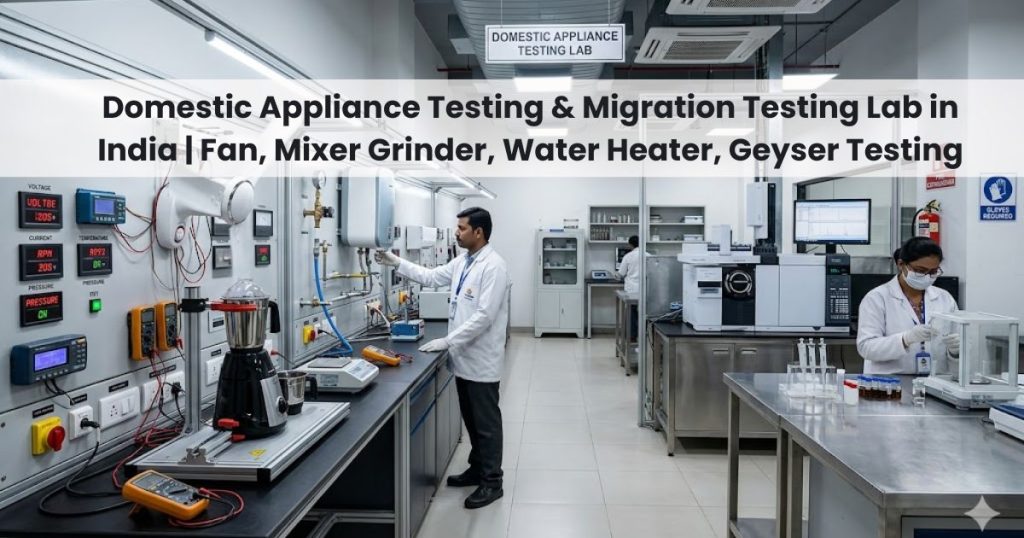
In today’s competitive market, product quality is no longer just a regulatory requirement—it is a key factor that influences customer trust, brand reputation, and long-term business growth. Whether you manufacture electrical appliances, food-contact packaging materials, cables, or construction materials, independent testing plays a critical role in ensuring compliance, safety, and performance.
At a professional testing laboratory, every product undergoes rigorous evaluation before reaching consumers. From domestic appliances used in homes every day to specialized industrial materials, testing helps manufacturers identify risks, improve quality, and meet national and international standards.
This guide explores the importance of domestic appliance testing, migration testing, RCPT testing, HFFR testing, and other essential laboratory services available in India.
Domestic Appliance Testing
Domestic appliance testing is essential for verifying the safety, efficiency, durability, and performance of household electrical products. Consumers expect appliances to operate safely under different conditions, and manufacturers must ensure that their products meet applicable quality standards before entering the market.
Testing laboratories evaluate appliances through a range of electrical, mechanical, thermal, and safety assessments. These tests help identify potential defects, reduce product recalls, and improve customer satisfaction.
Common products covered under domestic appliance testing include:
- Ceiling fans
- Mixer grinders
- Water heaters
- Geysers
- Electric kettles
- Induction cooktops
- Room heaters
- Kitchen appliances
By conducting comprehensive testing, manufacturers can demonstrate compliance with regulatory requirements while strengthening consumer confidence in their products.
Fan Testing
A ceiling fan may appear to be a simple product, but its performance depends on several technical factors. Proper fan testing helps determine whether the product delivers consistent airflow, consumes energy efficiently, and operates safely over an extended period.
Testing procedures often focus on:
- Air delivery performance
- Power consumption
- Speed regulation
- Temperature rise
- Endurance and durability
- Electrical insulation
- Mechanical strength
Accurate testing allows manufacturers to optimize product design and ensure reliable performance in real-world conditions. It also supports compliance with relevant standards and certification requirements.
As energy efficiency becomes increasingly important, fan testing provides valuable insights that help manufacturers create products that meet modern consumer expectations.
Mixer Grinder Testing
The kitchen appliance segment has witnessed significant growth in recent years, making mixer grinder testing more important than ever. Consumers expect these appliances to handle daily use while maintaining safety and performance.
Testing laboratories assess various parameters to evaluate product quality, including:
- Motor efficiency
- Load handling capability
- Blade performance
- Noise levels
- Electrical safety
- Mechanical durability
- Continuous operation performance
A well-tested mixer grinder offers better reliability and a longer service life. Manufacturers also benefit by identifying potential issues during the development stage rather than after the product reaches the market.
Regular testing contributes to improved product quality and reduced warranty claims.
Water Heater Testing Lab
Water heaters are among the most frequently used electrical appliances in residential and commercial environments. Because they combine electricity and water, safety remains a top priority.
A certified water heater testing lab evaluates products to ensure they meet performance and safety requirements before commercialization.
Typical testing parameters include:
- Heating efficiency
- Temperature control accuracy
- Leakage current
- Insulation resistance
- Pressure resistance
- Thermostat functionality
- Energy consumption
Manufacturers rely on water heater testing laboratories to verify product quality and support certification processes. These evaluations help ensure that users receive safe and efficient products capable of performing under various operating conditions.
Geyser Testing Lab
A professional geyser testing lab provides comprehensive testing services to assess the safety, reliability, and durability of electric storage and instant water heaters.
Testing may include:
- Electrical safety assessment
- Earth continuity verification
- Thermal performance testing
- Pressure endurance testing
- Corrosion resistance evaluation
- Long-term durability assessment
Consumers expect geysers to function safely throughout their service life. Thorough testing helps manufacturers maintain quality standards while minimizing the risk of product failure.
The testing process also assists companies in meeting regulatory requirements and building greater trust among customers.
RCPT Test
The RCPT test (Rapid Chloride Permeability Test) is widely used in the construction industry to evaluate the durability of concrete structures.
Concrete structures are often exposed to aggressive environmental conditions. Chloride penetration can lead to reinforcement corrosion, ultimately affecting structural integrity. RCPT testing helps engineers assess how effectively concrete resists chloride ion penetration.
Benefits of RCPT testing include:
- Evaluation of concrete durability
- Assessment of corrosion resistance
- Quality control for construction projects
- Verification of material performance
- Support for infrastructure longevity
The RCPT test is commonly performed for bridges, tunnels, marine structures, highways, and commercial buildings where durability is a critical requirement.
HFFR Testing
Modern cable systems increasingly utilize halogen-free materials to improve fire safety. HFFR testing (Halogen Free Flame Retardant Testing) helps determine whether materials meet required safety and performance criteria.
HFFR materials are designed to:
- Reduce toxic gas emissions
- Minimize smoke generation
- Improve fire safety
- Enhance evacuation conditions during emergencies
Testing laboratories evaluate:
- Flame retardancy
- Halogen content
- Smoke density
- Thermal stability
- Material composition
Manufacturers serving the infrastructure, transportation, energy, and telecommunications sectors often require HFFR testing to verify compliance with industry standards.
The demand for HFFR-certified materials continues to grow as safety regulations become more stringent worldwide.
Migration Testing Lab
Food safety remains a major concern across the packaging industry. A qualified Migration Testing Lab helps manufacturers determine whether substances from packaging materials migrate into food products during storage and usage.
Migration testing is commonly performed on:
- Plastic containers
- Food packaging films
- Bottles and closures
- Kitchenware products
- Food-contact materials
Testing procedures evaluate the transfer of substances under controlled conditions to ensure compliance with food safety regulations.
A reliable migration testing laboratory provides accurate data that supports regulatory approval and consumer protection. Manufacturers can use these results to demonstrate product safety and maintain compliance with national and international requirements.
Best Migration Testing Lab
Selecting the Best Migration Testing Lab is a critical decision for food packaging manufacturers and exporters.
An ideal laboratory should offer:
Advanced Testing Infrastructure
Modern analytical instruments improve accuracy and reliability while supporting complex testing requirements.
Experienced Technical Experts
Qualified scientists and engineers ensure proper testing methodologies and precise interpretation of results.
Regulatory Compliance Support
A reputable laboratory understands the requirements of food safety authorities and international standards.
Reliable Reporting
Timely and accurate reports help manufacturers make informed decisions and avoid delays in product launches.
Quality Assurance
Accredited laboratories follow strict quality management systems that ensure consistency and confidence in testing outcomes.
Partnering with the best migration testing laboratory enables businesses to maintain product safety while meeting regulatory obligations efficiently.
Migration Test in India
The demand for Migration Test in India has increased significantly due to growing food safety awareness and stricter compliance requirements.
Migration testing helps determine whether packaging materials release substances that could affect food quality or consumer health.
The process generally includes:
- Overall migration testing
- Specific migration testing
- Compliance evaluation
- Material characterization
- Safety assessment
Industries that commonly require migration testing include:
- Food packaging manufacturers
- Beverage companies
- Plastic processing industries
- Kitchenware manufacturers
- Export-oriented businesses
A migration test conducted by an accredited laboratory provides confidence that food-contact materials meet applicable safety standards and regulatory requirements.
Why Professional Testing Laboratories Matter
Manufacturers today operate in a highly regulated environment where product safety, quality, and compliance directly influence market success.
Professional laboratories help organizations:
- Improve product quality
- Meet BIS and industry requirements
- Reduce compliance risks
- Enhance consumer confidence
- Support certification processes
- Minimize product failures
- Strengthen brand reputation
Testing is not merely a regulatory formality. It serves as a valuable quality assurance tool that supports innovation, reliability, and customer satisfaction.
Conclusion
As consumer expectations and regulatory requirements continue to evolve, independent testing has become an essential part of product development and quality assurance. Whether you require domestic appliance testing, fan testing, mixer grinder testing, services from a water heater testing lab, support from a geyser testing lab, an RCPT test, HFFR testing, a trusted Migration Testing Lab, the Best Migration Testing Lab, or a Migration Test in India, choosing an experienced and accredited laboratory can make a significant difference.
Accurate testing helps manufacturers deliver safer products, maintain compliance, and build lasting trust in the marketplace. By investing in professional laboratory services, businesses position themselves for sustainable growth while ensuring the highest standards of quality and safety.
FAQs
1. What is domestic appliance testing?
Domestic appliance testing evaluates household electrical products for safety, performance, and compliance.
2. Why is domestic appliance testing important?
It helps ensure product safety, reliability, and adherence to regulatory standards.
3. What is fan testing?
Fan testing measures airflow, energy efficiency, durability, and electrical safety.
4. Why is fan testing required?
It verifies that fans perform efficiently and safely under normal operating conditions.
5. What is mixer grinder testing?
Mixer grinder testing assesses motor performance, safety, durability, and operational efficiency.
6. What are the benefits of mixer grinder testing?
It improves product quality, reliability, and consumer safety.
7. What does a water heater testing lab do?
A water heater testing lab evaluates heating performance, energy efficiency, and electrical safety.
8. Why choose a certified water heater testing lab?
Certified labs provide accurate results and support regulatory compliance.
9. What is a geyser testing lab?
A geyser testing lab tests water heaters for safety, performance, and durability.
10. What tests are performed in a geyser testing lab?
Common tests include thermal performance, pressure resistance, and electrical safety assessments.