
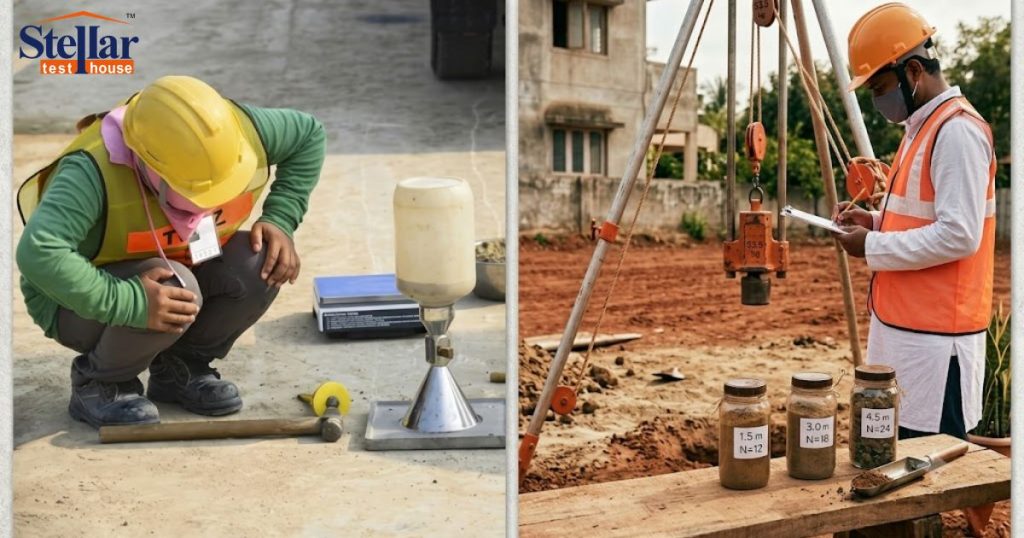
The strength, durability, and safety of any construction project depend on the quality of its materials. Whether you are building a residential home, commercial complex, industrial facility, bridge, or highway, testing construction materials before and during construction is essential. A Construction Material Testing Laboratory ensures that soil, cement, bricks, and concrete meet the required quality standards and comply with Indian Standards (IS Codes).
A professional Soil Testing Lab, Cement Testing Lab, Brick Testing Lab, and Concrete Testing Lab provides accurate testing results that help engineers, builders, contractors, architects, and project owners make informed decisions. These tests improve structural safety, reduce maintenance costs, and ensure compliance with national quality standards.
This guide explains the importance of construction material testing, common testing methods, applicable IS standards, and how to choose the right testing laboratory in India.
What is Construction Material Testing?
Construction Material Testing (CMT) is the process of evaluating the physical, mechanical, and chemical properties of building materials before they are used in construction. Testing helps determine whether materials meet project specifications, regulatory requirements, and safety standards.
Construction material testing includes:
- Soil Testing
- Cement Testing
- Brick Testing
- Concrete Testing
- Aggregate Testing
- Steel Reinforcement Testing
- Water Quality Testing
- Bitumen Testing
Regular testing minimizes construction defects, improves quality control, and increases the lifespan of buildings and infrastructure projects.
Soil Testing Laboratory
A Soil Testing Lab plays a critical role before the construction of buildings, bridges, roads, and industrial structures. Soil investigation helps engineers understand the soil’s bearing capacity, composition, moisture content, and stability before designing the foundation.
If you are planning a project in Delhi NCR, choosing a reliable Soil Testing Lab in Noida ensures accurate geotechnical investigation and compliance with project requirements.
Common Soil Tests
- Soil Bearing Capacity Test (SBC)
- Moisture Content Test
- Grain Size Analysis
- Atterberg Limits Test
- Proctor Compaction Test
- California Bearing Ratio (CBR) Test
- Permeability Test
- Specific Gravity Test
Benefits of Soil Testing
- Selects the right foundation type
- Prevents settlement and foundation failure
- Improves structural stability
- Reduces construction risks
- Optimizes project cost
Cement Testing Laboratory
Cement is one of the most important construction materials. A professional Cement Testing Lab evaluates the quality and performance of cement before it is used in concrete production.
For builders and contractors in Delhi NCR, a trusted Cement Testing Lab in Noida helps verify whether cement complies with Indian Standards and project specifications.
Common Cement Tests
- Fineness Test
- Initial & Final Setting Time
- Compressive Strength Test
- Soundness Test
- Consistency Test
- Specific Gravity Test
Testing ensures that cement provides the required strength and durability for long-lasting construction.
Brick Testing Laboratory
Bricks form the backbone of masonry structures. A Brick Testing Lab evaluates brick quality to ensure they can withstand structural loads and environmental conditions.
Choosing a certified Brick Testing Lab in Noida helps contractors verify the quality of construction materials before use.
Common Brick Tests
- Compressive Strength Test
- Water Absorption Test
- Efflorescence Test
- Dimensions & Shape Test
- Hardness Test
- Impact Test
Poor-quality bricks may lead to cracks, moisture penetration, and reduced structural life.
Concrete Testing Laboratory
Concrete is the primary material used in buildings, bridges, dams, highways, and industrial structures. A professional Concrete Testing Lab performs quality assessments to verify strength, durability, and workability.
If your project is located in Delhi NCR, a reliable Concrete Testing Lab in Noida provides testing services that comply with IS standards.
Common Concrete Tests
- Slump Test
- Cube Compressive Strength Test
- Flexural Strength Test
- Split Tensile Strength Test
- Density Test
- Water Permeability Test
- Rebound Hammer Test
- Ultrasonic Pulse Velocity (UPV) Test
These tests help ensure concrete performs safely throughout the service life of the structure.
Comparison of Construction Material Testing
| Material | Purpose of Testing | Common Tests |
|---|---|---|
| Soil | Evaluate foundation suitability | SBC, CBR, Moisture Content, Grain Size |
| Cement | Verify quality and strength | Setting Time, Fineness, Compressive Strength |
| Brick | Check durability and load capacity | Water Absorption, Compressive Strength |
| Concrete | Assess structural performance | Cube Test, Slump Test, UPV, Rebound Hammer |
Why Construction Material Testing is Important
Testing construction materials offers several advantages:
- Ensures structural safety
- Verifies compliance with IS standards
- Improves construction quality
- Reduces repair and maintenance costs
- Prevents premature structural failures
- Supports quality assurance and quality control
- Enhances the durability of buildings and infrastructure
- Helps engineers select suitable construction materials
Indian Standards Used for Construction Material Testing
Professional laboratories follow Indian Standards (IS Codes) for reliable and standardized testing.
Some commonly used standards include:
- IS 2720 – Methods of Test for Soils
- IS 4031 – Physical Tests for Hydraulic Cement
- IS 3495 – Methods of Tests for Burnt Clay Bricks
- IS 516 – Methods of Tests for Strength of Concrete
- IS 456 – Plain and Reinforced Concrete Code of Practice
- IS 10262 – Concrete Mix Proportioning Guidelines
Following these standards ensures test accuracy, consistency, and compliance with regulatory requirements.
How to Choose the Right Construction Material Testing Laboratory
When selecting a testing laboratory, consider the following factors:
- NABL Accreditation
- Experienced engineers and technicians
- Modern testing equipment
- Compliance with IS, ASTM, and ISO standards
- Timely test reports
- On-site sample collection (if required)
- Transparent testing procedures
- Proven industry experience
A reputed laboratory provides reliable results that support safe and durable construction projects.
Conclusion
Construction material testing is an essential step in ensuring the quality, safety, and longevity of any building or infrastructure project. Whether you require services from a Soil Testing Lab, Cement Testing Lab, Brick Testing Lab, or Concrete Testing Lab, choosing a trusted and experienced laboratory ensures compliance with Indian Standards and helps prevent costly construction failures.
For projects in Delhi NCR, selecting a reliable Soil Testing Lab in Noida, Cement Testing Lab in Noida, Brick Testing Lab in Noida, and Concrete Testing Lab in Noida provides accurate testing results that support better engineering decisions, improved quality control, and long-term structural performance.
Frequently Asked Questions (FAQs)
1. What is Soil Testing?
Soil testing is the process of analyzing soil properties such as bearing capacity, moisture content, density, and composition to determine whether the ground is suitable for construction.
2. Why is Soil Testing Important Before Construction?
Soil testing helps engineers design safe foundations, identify weak soil conditions, prevent settlement, and improve the stability and durability of structures.
3. What Tests are Performed on Cement?
Common cement tests include fineness, standard consistency, initial and final setting time, compressive strength, soundness, and specific gravity.
4. Why is Concrete Cube Testing Important?
Concrete cube testing measures the compressive strength of concrete, ensuring it meets the design requirements and can safely support structural loads.
5. How is Brick Compressive Strength Tested?
Brick compressive strength is determined by applying a controlled load in a compression testing machine until the brick fails. The result indicates its load-bearing capacity.
6. Which IS Standards are Used for Construction Material Testing?
Common standards include IS 2720 (Soil), IS 4031 (Cement), IS 3495 (Bricks), IS 516 (Concrete), IS 456, and IS 10262.
7. How Much Does Soil Testing Cost in India?
The cost varies depending on the project size, number of samples, required tests, and site location. Contact a NABL-accredited laboratory for an accurate quotation.
8. How Long Does Construction Material Testing Take?
Most routine tests are completed within 2–7 working days, although timelines may vary based on the type of material, testing scope, and laboratory workload.