
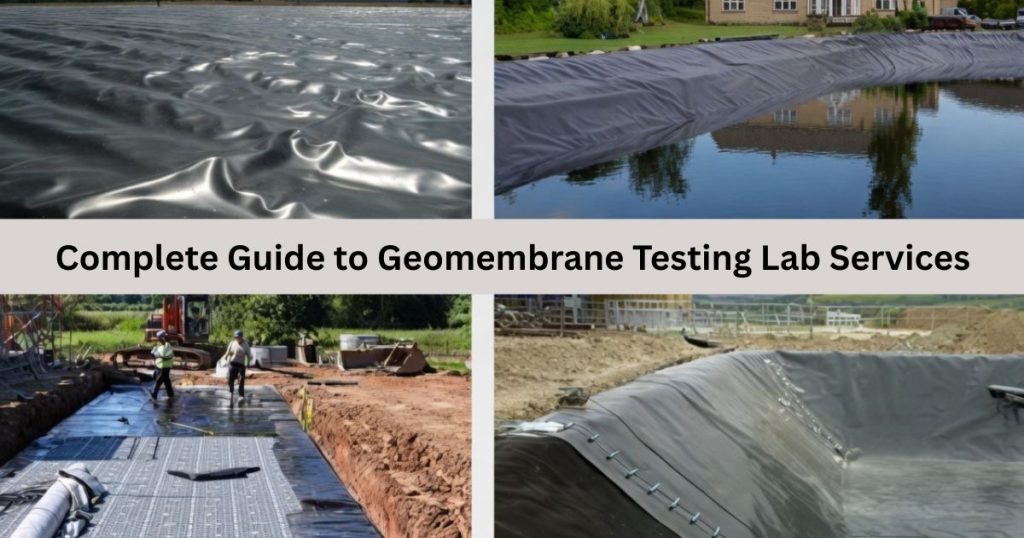
When a landfill starts leaking, a mining containment pond develops cracks, or a water reservoir loses stored water unexpectedly, the problem often traces back to one critical component: the liner system.
Geomembranes act as protective barriers in some of the world’s most demanding engineering projects. Their job sounds simple—prevent leakage and contain liquids—but the consequences of failure can be severe. Environmental contamination, regulatory penalties, project delays, expensive repairs, and reputational damage are all possible outcomes when a geomembrane does not perform as expected.
This is why professional geomembrane testing Lab has become an essential part of modern infrastructure, environmental, and industrial projects.
Whether you are a contractor, project consultant, government authority, geosynthetic manufacturer, or quality engineer, testing helps verify that the material meets technical specifications before installation and continues to deliver reliable performance throughout its service life.
At Stellar Test House, NABL-accredited geomembrane testing services help organizations evaluate material quality using standardized laboratory procedures and advanced testing equipment.
This guide explains everything you need to know about geomembrane testing, why it matters, which standards are commonly used, and how professional laboratory analysis supports successful project outcomes.
What Is Geomembrane Testing?
Geomembrane testing is the scientific evaluation of geosynthetic liner materials to determine their physical, mechanical, thermal, hydraulic, and durability characteristics.
The primary objective is simple: ensure the material can perform safely under actual field conditions.
A geomembrane may face several challenges during its service life:
- Heavy loads from soil or waste material
- Sharp stones and puncture hazards
- Continuous exposure to sunlight
- Temperature fluctuations
- Chemical exposure
- Seam stress during installation
- Ground settlement and movement
Laboratory testing helps identify whether the material can withstand these conditions without failure.
Instead of relying solely on manufacturer specifications, project stakeholders obtain independent verification of material quality through accredited testing.
Why Geomembrane Quality Matters More Than Most People Realize
Many project failures do not occur because the design was incorrect. They occur because the installed material failed to meet performance expectations.
Consider a landfill project.
A tiny defect in the liner system may initially go unnoticed. Over time, however, leachate can seep through damaged sections and contaminate surrounding soil or groundwater. Fixing the issue later often costs significantly more than conducting proper testing before installation.
The same applies to:
- Mining tailing ponds
- Industrial waste containment facilities
- Wastewater treatment plants
- Reservoir lining projects
- Agricultural water storage systems
Testing provides confidence that the selected material is suitable for the intended application.
Common Applications of Geomembrane Liners
Geomembranes are used across multiple industries because of their excellent containment properties.
Environmental Protection Projects
Environmental engineers use geomembranes to prevent pollutants from entering soil and groundwater.
Applications include:
- Landfill liner systems
- Hazardous waste containment
- Environmental remediation projects
- Leachate collection systems
Water Management Systems
Water conservation projects depend heavily on reliable liner performance.
Common examples include:
- Irrigation ponds
- Water reservoirs
- Canal lining systems
- Rainwater harvesting structures
Mining Industry
Mining operations often store chemically active materials.
Geomembranes help contain:
- Tailings
- Process water
- Heap leach solutions
- Chemical storage ponds
Industrial Applications
Many industries use geomembranes for secondary containment systems.
Examples include:
- Chemical processing plants
- Power stations
- Oil and gas facilities
- Industrial wastewater treatment plants
Why Professional Geomembrane Testing Is Essential
Some organizations view testing as a compliance requirement.
Experienced project teams view it differently.
Testing acts as risk management.
Without Testing
Potential issues include:
- Premature liner failure
- Leakage and contamination
- Poor seam performance
- Reduced service life
- Project delays
- Regulatory concerns
With Professional Testing
Organizations gain:
- Independent quality verification
- Compliance with project specifications
- Reduced operational risk
- Improved installation confidence
- Better long-term performance
The cost of testing is often insignificant compared to the financial impact of liner failure.
Key Geomembrane Properties Evaluated in Laboratories
A professional geomembrane testing laboratory evaluates multiple characteristics to provide a complete understanding of material performance.
| Property | Why It Matters |
|---|---|
| Thickness | Influences strength and durability |
| Density | Indicates material consistency |
| Tensile Strength | Measures resistance to pulling forces |
| Puncture Resistance | Evaluates protection against sharp objects |
| Seam Strength | Ensures weld integrity |
| UV Resistance | Determines outdoor durability |
| Carbon Black Content | Supports weather resistance |
| Stress Crack Resistance | Predicts long-term performance |
| Thermal Stability | Assesses heat resistance |
Each parameter contributes to the overall reliability of the geomembrane system.
Tensile Strength Testing (ASTM D6693)
What Is Tensile Strength?
Tensile strength measures how much pulling force a geomembrane can withstand before it stretches excessively or breaks.
This property becomes especially important when liners experience:
- Ground movement
- Differential settlement
- Installation stress
- Heavy loading conditions
What Does the Test Measure?
ASTM D6693 typically evaluates:
- Yield strength
- Break strength
- Elongation at yield
- Elongation at break
Practical Example
Imagine a landfill where waste loading gradually increases over several years.
A geomembrane with insufficient tensile properties may deform under stress, creating weak points that eventually lead to failure.
Testing helps identify these risks before installation.
Puncture Resistance Testing (ASTM D4833)
One of the most common causes of liner damage occurs during installation.
Even a small stone beneath the liner can create localized stress.
Over time, this stress may puncture the geomembrane.
Why Puncture Resistance Matters
Projects frequently expose liners to:
- Gravel
- Sharp rocks
- Construction equipment
- Waste materials
Puncture testing evaluates the material’s ability to resist penetration under controlled laboratory conditions.
Benefits
- Improved installation reliability
- Reduced leakage risk
- Better field performance
- Longer service life
For mining and landfill applications, puncture resistance is often a critical acceptance parameter.
Seam and Weld Strength Testing (ASTM D6392)
Even the highest-quality geomembrane sheet can fail if the seams are poorly welded.
In real-world installations, seams are often the most vulnerable areas of the liner system.
Why Seam Testing Is Important
Every welded joint must perform as effectively as the parent material.
Testing evaluates:
- Shear strength
- Peel adhesion
- Weld consistency
- Bond integrity
Real-World Scenario
During a reservoir lining project, hundreds of seam joints may be created.
If only one critical seam fails, leakage can occur despite the overall quality of the liner material.
Professional seam testing helps identify defects before the system becomes operational.
HDPE Geomembrane Testing
High-Density Polyethylene (HDPE) geomembranes are among the most widely used liner materials worldwide.
Their popularity comes from:
- Excellent chemical resistance
- High durability
- Cost-effectiveness
- Long service life
Common HDPE Evaluations
Oxidative Induction Time (OIT)
Measures resistance to oxidation and aging.
Stress Crack Resistance
Evaluates susceptibility to cracking under long-term stress.
Thermal Stability
Assesses performance under elevated temperatures.
Chemical Resistance
Determines compatibility with aggressive chemicals.
These tests help predict long-term field performance.
Carbon Black Content and Dispersion Testing (ASTM D5596)
Outdoor geomembranes continuously face UV exposure.
Without adequate UV protection, degradation can occur much faster than expected.
Why Carbon Black Matters
Carbon black acts as a protective additive that improves resistance to sunlight and weathering.
Proper dispersion ensures:
- Uniform protection
- Improved durability
- Reduced degradation
- Longer service life
Practical Insight
Two geomembranes may appear identical visually.
However, poor carbon black distribution can significantly reduce long-term performance.
This is why laboratory verification remains important.
Thickness Testing (ASTM D5199)
Thickness is one of the most basic yet important quality parameters.
Even minor variations can affect performance characteristics.
Why Thickness Testing Is Conducted
Thickness influences:
- Mechanical strength
- Puncture resistance
- Durability
- Design compliance
Common Quality Concerns
Testing helps identify:
- Manufacturing inconsistencies
- Material variation
- Specification non-compliance
For many projects, thickness verification forms part of the acceptance process before installation begins.
ASTM Standards Commonly Used for Geomembrane Evaluation
Accurate testing depends on standardized procedures.
The following ASTM standards are widely recognized across the industry:
| ASTM Standard | Purpose |
|---|---|
| ASTM D6693 | Tensile Properties |
| ASTM D4833 | Puncture Resistance |
| ASTM D6392 | Seam Strength Evaluation |
| ASTM D5199 | Thickness Measurement |
| ASTM D5596 | Carbon Black Dispersion |
| ASTM D3895 | Oxidative Induction Time |
| ASTM D5397 | Stress Crack Resistance |
Following recognized standards improves consistency, credibility, and project acceptance.
How Geomembrane Testing Supports Project Success
Successful projects rarely depend on a single factor.
Instead, they result from consistent quality control throughout planning, procurement, installation, and operation.
Professional testing contributes by:
Reducing Financial Risk
Early detection of material issues prevents expensive repairs later.
Supporting Regulatory Compliance
Many government and environmental projects require documented testing.
Improving Installation Quality
Verified materials reduce installation challenges.
Increasing Service Life
Better materials generally deliver longer operational performance.
Industries That Commonly Require Geomembrane Testing
Geomembrane testing supports a wide range of sectors.
Infrastructure Development
- Highways
- Railways
- Urban development projects
Mining Operations
- Tailing ponds
- Process water containment
Environmental Engineering
- Landfills
- Hazardous waste facilities
Water Resource Management
- Reservoirs
- Irrigation projects
Agriculture
- Farm ponds
- Water storage systems
Industrial Facilities
- Chemical containment
- Wastewater treatment
How to Choose the Right Geomembrane Testing Laboratory
Selecting a laboratory should involve more than comparing prices.
Reliable testing depends on expertise, equipment, and accreditation.
Key Factors to Evaluate
NABL Accreditation
Accreditation demonstrates technical competence and quality management.
Industry Experience
Experienced laboratories understand project-specific requirements.
Testing Capability
Ensure required ASTM standards are available.
Reporting Quality
Reports should be detailed, clear, and technically sound.
Turnaround Time
Timely reporting supports project schedules.
Technical Support
Expert interpretation adds value beyond raw test results.
Why Many Organizations Prefer NABL-Accredited Testing
NABL accreditation provides confidence that testing procedures follow recognized quality standards.
Benefits include:
- Reliable results
- Better industry acceptance
- Improved regulatory compliance
- Standardized procedures
- Increased stakeholder confidence
For government and large-scale infrastructure projects, accreditation is often a mandatory requirement.
Why Choose Stellar Test House for Geomembrane Testing?
Stellar Test House supports manufacturers, contractors, consultants, and project authorities through professional testing services.
NABL Accredited Laboratory
Testing performed under recognized quality systems.
Advanced Testing Equipment
Modern instruments help ensure accurate measurements.
Experienced Technical Team
Qualified professionals with geosynthetic testing expertise.
ASTM-Compliant Procedures
Testing follows internationally recognized standards.
Fast Reporting
Quick turnaround supports project timelines.
Comprehensive Technical Reports
Clear documentation helps decision-making and compliance verification.
Frequently Asked Questions (FAQs)
1. Why is geomembrane testing important before installation?
Testing verifies whether the material meets project specifications and can withstand expected field conditions. It helps prevent failures, leakage, and costly repairs.
2. What is the most important geomembrane test?
There is no single most important test. Tensile strength, puncture resistance, seam strength, thickness, and durability evaluations all contribute to overall performance assessment.
3. Which industries commonly require geomembrane testing?
Mining, landfill engineering, wastewater treatment, environmental protection, water management, agriculture, and industrial containment sectors regularly require geomembrane testing.
4. What is ASTM D6693 used for?
ASTM D6693 evaluates tensile properties such as yield strength, break strength, and elongation characteristics of geomembrane materials.
5. Why is seam testing critical for geomembrane installations?
Seams are often the weakest part of a liner system. Proper seam testing ensures welded joints maintain strength and leak resistance throughout the service life.
6. Why should I choose an NABL-accredited testing laboratory?
NABL-accredited laboratories follow standardized procedures, maintain quality systems, and provide reports that are widely accepted by consultants, government agencies, and project authorities.
Conclusion
Geomembranes play a vital role in protecting infrastructure, water resources, industrial facilities, and the environment. However, even the best-designed containment system depends on the quality of the liner material installed on site.
Professional geomembrane testing provides the confidence needed to make informed decisions before installation begins. From tensile strength and puncture resistance to seam integrity and UV durability, each test helps uncover potential weaknesses that could become expensive problems later.
For contractors, consultants, manufacturers, and project owners, testing is not merely a compliance requirement—it is a practical investment in performance, safety, and long-term reliability.
Stellar Test House offers NABL-accredited geomembrane testing services using ASTM-compliant procedures and advanced laboratory equipment to support infrastructure, mining, environmental, and industrial projects. By verifying material quality before deployment, organizations can reduce risk, improve operational performance, and achieve greater confidence in the success of their containment systems.