
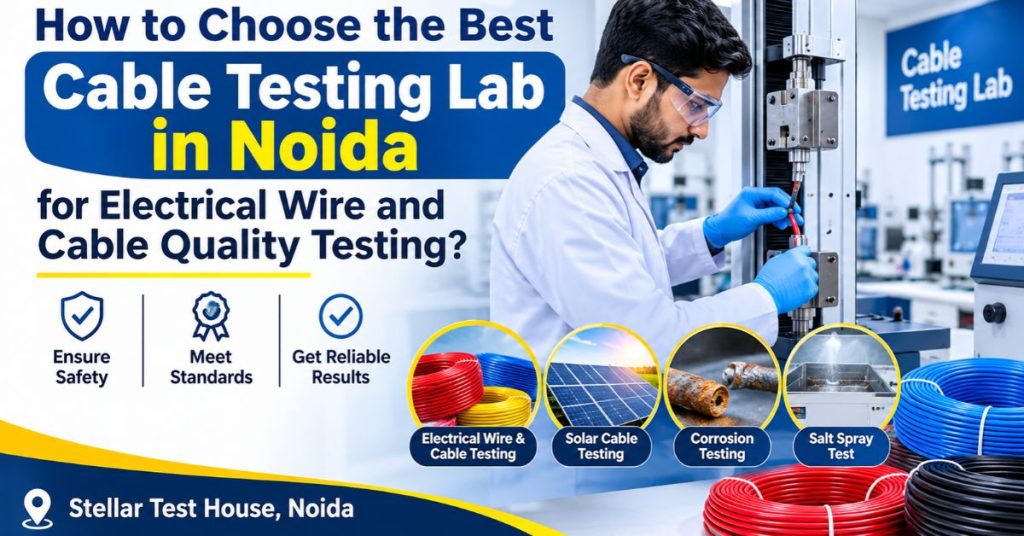
Choosing the right cable testing laboratory is an important step for cable manufacturers, electrical contractors, infrastructure developers, and businesses involved in electrical installations. Electrical wires and cables carry power across residential buildings, commercial projects, industrial facilities, and renewable energy systems. Even a small quality issue can affect electrical safety, product performance, and long-term reliability.
If you are looking for a reliable Cable Testing Lab in Noida, you should consider more than just testing charges and turnaround time. The laboratory’s accreditation, testing facilities, technical expertise, applicable standards, and reporting process all play an important role.
A professional cable testing lab helps manufacturers and buyers verify whether their electrical wires and cables meet the required quality and safety specifications before they enter the market or become part of an electrical installation.
In this guide, we will explain how to select the right cable testing laboratory, which tests are important, what standards you should check, and how professional testing can help improve cable quality.
Why Is Electrical Wire and Cable Testing Important?
Electrical wires and cables work under different environmental and operating conditions. Depending on their application, they may experience heat, moisture, mechanical stress, voltage fluctuations, and chemical exposure.
Without proper testing, manufacturers may find it difficult to identify defects that affect cable performance.
Electrical cables and wires testing Lab helps businesses:
- Check the electrical safety and performance of cables.
- Verify insulation and sheath quality.
- Identify manufacturing defects.
- Evaluate resistance to heat and environmental conditions.
- Check mechanical strength and durability.
- Verify compliance with applicable Indian and international standards.
- Maintain product quality during manufacturing.
For cable manufacturers, regular testing also supports quality control and helps build customer confidence.
What Services Should a Professional Cable Testing Lab Offer?
Before selecting a laboratory, check whether it provides the testing facilities required for your cable type and application.
A professional electrical testing laboratory may offer several testing services.
1. Electrical Testing of Wires and Cables
Electrical testing checks the performance and safety characteristics of electrical cables under specified test conditions.
Some important electrical tests include:
- Conductor resistance test
- Insulation resistance test
- High voltage test
- Voltage withstand test
- Continuity test
- Conductor resistance measurement
These tests help evaluate whether the cable meets its specified electrical requirements.
2. Mechanical Testing of Cables
Mechanical properties affect how cables perform during installation and regular use.
Important mechanical tests may include:
- Tensile strength test
- Elongation at break test
- Ageing test
- Pressure test
- Shrinkage test
- Dimensional measurement
These tests help evaluate the strength, flexibility, and physical characteristics of cable insulation and sheathing materials.
3. Thermal and Environmental Testing
Electrical cables may operate in challenging environmental conditions. Heat, moisture, and temperature variations can affect their insulation and overall performance.
Depending on the applicable product standard, testing may include:
- Heat resistance test
- Thermal ageing test
- Low-temperature test
- Flame propagation test
- Environmental exposure testing
A suitable testing laboratory can help manufacturers evaluate cable performance under relevant conditions.
Solar Cable and Photovoltaic Cable Testing
With the growing use of solar power systems, the demand for reliable solar cables has increased. Photovoltaic (PV) cables connect solar panels, inverters, and other electrical components. They must withstand outdoor exposure and demanding operating conditions.
Solar cable testing evaluates important properties such as:
- Insulation and sheath performance
- Conductor resistance
- Voltage withstand capability
- Heat resistance
- UV and weathering resistance
- Mechanical properties
- Ageing performance
For photovoltaic cable testing, manufacturers should check the relevant product specifications and applicable standards, such as IS 17293 and IEC 62930, depending on the cable type and intended application.
If your business manufactures or supplies solar cables, choose a laboratory with suitable facilities and an appropriate testing scope for photovoltaic cable evaluation.
Corrosion Testing and Salt Spray Test for Cable Components
Some cable applications involve exposure to moisture, humidity, chemicals, and corrosive environments. These conditions can affect metallic components, connectors, coatings, and other cable-related materials.
A Corrosion Testing Lab helps evaluate how materials respond to corrosive conditions.
One commonly used method is the salt spray test.
What Is a Salt Spray Test?
A salt spray test is an accelerated corrosion test that exposes test specimens to a controlled salt-containing environment inside a testing chamber.
It helps assess the corrosion resistance of metallic materials, protective coatings, and surface treatments.
The test may be relevant for:
- Metal cable accessories
- Connectors and terminals
- Metallic protective components
- Coated cable fittings
- Electrical enclosures and hardware
ASTM B117 and ISO 9227 are commonly referenced standards for salt spray testing.
Important: Salt spray testing does not directly establish the complete service life of a cable. The test method and duration should match the material, coating, and actual application requirements.
Which Standards Should You Check Before Cable Testing?
Testing standards define the procedures, requirements, and acceptance criteria for evaluating electrical wires and cables.
The applicable standard depends on the cable construction, voltage rating, material, and intended application.
Some commonly referenced standards include:
| Standard | Application |
|---|---|
| IS 694 | PVC insulated cables for working voltages up to and including 1100 V |
| IS 1554 | PVC insulated heavy-duty electric cables |
| IS 7098 | XLPE insulated cables |
| IS 17293 | Solar DC cables |
| IEC 60227 | PVC insulated cables |
| IEC 60502 | Power cables with extruded insulation |
| IEC 62930 | Electric cables for photovoltaic systems |
| ASTM B117 | Salt spray testing |
| ISO 9227 | Corrosion testing in artificial atmospheres |
Always confirm the latest applicable edition and specific requirements before submitting samples.
7 Important Factors to Consider When Choosing the Best Cable Testing Lab in Noida
Not every laboratory offers the same testing facilities or technical capabilities. Before selecting a cable testing lab, consider these seven points.
1. Check NABL Accreditation
NABL accreditation is an important factor when selecting a testing laboratory.
However, do not simply check whether a laboratory has a NABL accreditation certificate. Verify whether the specific cable tests you require fall within its current accredited scope.
You can check the laboratory’s accreditation details and scope before proceeding.
2. Verify Testing Facilities and Equipment
A reliable laboratory should have suitable testing equipment for the required electrical, mechanical, thermal, and environmental tests.
Ask whether the laboratory can perform all the tests mentioned in your product specification.
3. Check Technical Expertise
Cable testing requires knowledge of electrical properties, insulation materials, product standards, and testing procedures.
Choose a laboratory with qualified technical personnel who can understand your requirements and guide you regarding the appropriate testing methods.
4. Ask About Testing Time and Report Delivery
Manufacturers often work with production schedules, client approvals, and dispatch deadlines.
Before submitting samples, confirm:
- Expected testing duration
- Sample quantity requirements
- Report delivery timeline
- Testing charges
- Additional testing requirements, if any
Clear communication helps avoid unnecessary delays.
5. Review the Testing Report
A professional testing report should clearly mention the sample details, test methods, applicable standards, test results, and relevant observations.
Check whether the report provides the information needed for your quality assurance or customer approval process.
6. Consider Location and Sample Submission
If your business operates in Noida, Delhi, Greater Noida, Ghaziabad, or other parts of NCR, selecting an accessible laboratory can make sample submission and communication easier.
A local cable testing lab can also simplify coordination for repeat testing and ongoing quality checks.
7. Compare Services, Not Just Prices
The lowest testing price may not always provide the right solution.
Compare laboratories based on their accreditation scope, available facilities, technical support, testing standards, and report quality.
A suitable laboratory should meet your actual testing requirements rather than simply offer the cheapest package.
Why Choose a Cable Testing Lab in Noida?
Noida and Greater Noida have a growing industrial and manufacturing ecosystem, including electrical equipment manufacturers, cable suppliers, infrastructure companies, and solar businesses.
Working with a professional testing laboratory in this region can offer several practical benefits:
- Convenient sample submission for NCR-based businesses.
- Better coordination with manufacturers and suppliers.
- Access to relevant electrical and mechanical testing services.
- Support for product quality verification.
- Assistance with applicable testing standards.
- Easier communication for repeat testing requirements.
For businesses operating in Delhi NCR, choosing a suitable Cable Testing Lab in Noida can simplify the product testing process.
Who Needs Electrical Wire and Cable Testing Services?
Cable testing is useful for businesses at different stages of manufacturing, procurement, and installation.
Typical customers include:
- Electrical wire and cable manufacturers
- Solar cable manufacturers
- Photovoltaic cable suppliers
- Electrical equipment manufacturers
- Infrastructure and construction companies
- Electrical contractors
- Industrial project developers
- Importers and distributors
- Quality control and inspection teams
Whether you manufacture electrical wires or purchase cables for a major infrastructure project, appropriate testing helps you make informed quality decisions.
Get Professional Cable Testing Services at Stellar Test House, Noida
Looking for a reliable Cable Testing Lab in Noida for electrical wire, power cable, solar cable, or photovoltaic cable testing?
Stellar Test House provides testing and quality evaluation services across multiple industries, including electrical and electronics, building materials, mechanical products, and other industrial applications.
Our laboratory supports businesses that require professional testing services for product quality verification and technical evaluation.
Before submitting your samples, our team can help you understand the relevant testing requirements, applicable standards, and sample submission process.
Contact Stellar Test House for:
- Electrical wire and cable testing requirements
- Cable quality and performance evaluation
- Solar and photovoltaic cable testing enquiries
- Corrosion and salt spray testing enquiries
- Testing requirements for manufacturers and suppliers
Stellar Test House
- Address: G-68, G-Block, Sector 63, Noida, Uttar Pradesh – 201301
- Website: https://stellartesthouse.com
- Email: [email protected]
Contact our team to discuss your cable testing requirements and get information about the available testing facilities, applicable standards, and quotation.
Frequently Asked Questions (FAQs)
1. What is a cable testing lab?
A cable testing lab evaluates electrical wires and cables to check their electrical, mechanical, thermal, and physical properties according to relevant product standards.
2. Where can I find a cable testing lab in Noida?
You can contact Stellar Test House, located in Sector 63, Noida, for information about available electrical wire and cable testing services.
3. Which tests are performed on electrical wires and cables?
Common tests include conductor resistance, insulation resistance, high voltage, tensile strength, elongation, ageing, and dimensional checks. The exact tests depend on the cable type and applicable standard.
4. Is solar cable testing different from normal cable testing?
Yes. Solar cables are designed for photovoltaic applications and may require additional evaluation of UV resistance, weathering, heat resistance, and other properties according to their applicable specifications.
5. What is the purpose of a salt spray test?
A salt spray test evaluates the corrosion resistance of metallic materials and protective coatings under controlled salt-containing conditions.
6. Why should I choose a NABL-accredited cable testing lab?
A NABL-accredited laboratory demonstrates technical competence for the specific tests included in its accredited scope. Always verify that the required cable tests are covered by the current scope.
7. What information is required before submitting cable samples?
Generally, laboratories may ask for the cable type, product specification, applicable standard, sample quantity, and required tests. Contact the laboratory to confirm the exact requirements.