
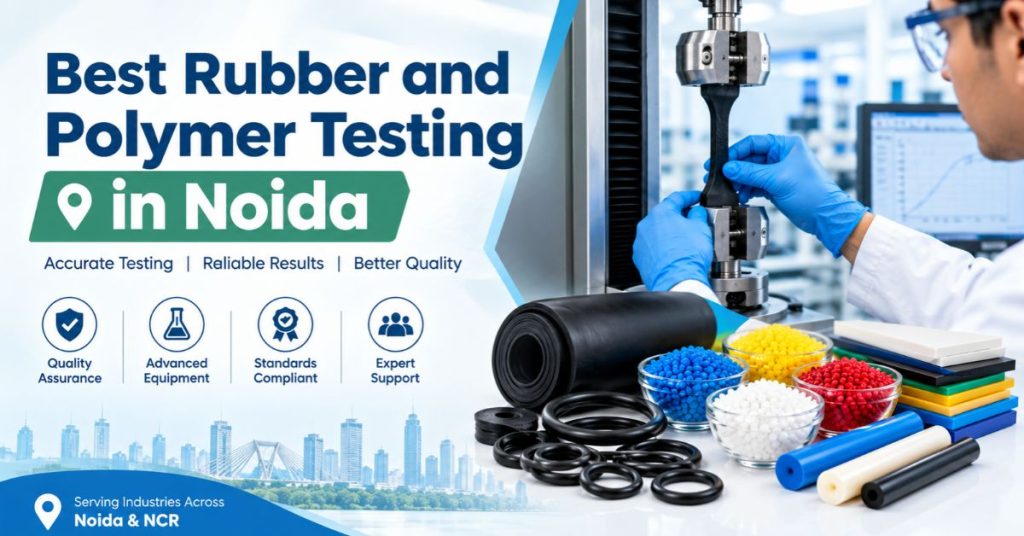
Rubber and polymer materials play an important role in modern manufacturing. From automotive components and electrical insulation to plastic packaging, industrial seals, pipes, and construction products, manufacturers depend on these materials for strength, flexibility, durability, and reliable performance.
However, not every rubber or polymer material performs equally under pressure, heat, environmental exposure, or repeated use. Even a small variation in material quality can affect product performance, increase manufacturing costs, and lead to customer complaints.
This is why choosing the right testing facility matters. A reliable polymer testing lab in Noida can help manufacturers evaluate material properties, identify quality issues, and make informed decisions before products reach the market.
But how do you find the right laboratory for your requirements? In this guide, we explain the important factors to consider when selecting the Best Rubber and Polymer Testing laboratory for your business.
What Is Rubber and Polymer Testing?
Rubber and polymer testing involves evaluating the physical, mechanical, thermal, and other relevant properties of rubber, plastic, and polymer-based materials. These tests help determine whether a material meets the specifications required for its intended application.
For example, a rubber gasket used in industrial equipment needs suitable elasticity and resistance to deformation. A plastic component used in an electrical product may require appropriate mechanical strength and thermal performance.
A professional rubber testing laboratory can help assess these properties using suitable testing methods, equipment, and documented procedures.
The exact tests depend on the material type, product application, customer specifications, and applicable Indian or international standards.
Why Is Choosing the Right Polymer Testing Lab Important?
Selecting a suitable laboratory is not simply about comparing prices. The quality of the testing process, the relevance of the selected methods, and the clarity of the final report all influence the value you receive.
Here are some important reasons to work with a reliable testing facility.
1. To Maintain Consistent Product Quality
Manufacturers need consistent material properties to produce reliable products. Testing helps identify variations between batches and provides useful information for quality-control decisions.
2. To Check Material Strength and Durability
Rubber and polymer products often experience stretching, compression, friction, temperature changes, or repeated use. Appropriate testing helps manufacturers understand how materials perform under specified conditions.
3. To Identify Potential Material Defects
Incorrect material composition, processing variations, or unsuitable raw materials may affect product performance. Testing can help identify deviations from specified requirements.
4. To Support Quality Assurance and Compliance
Many industries follow customer specifications, technical standards, or regulatory requirements. A suitable laboratory helps businesses obtain test results relevant to those requirements.
Remember that a test report alone does not automatically establish product certification or regulatory compliance. The applicable requirements must be checked separately.
How to Find the Best Polymer Testing Lab in Noida?
Before selecting a laboratory, compare its technical capabilities, testing scope, reporting process, and experience with your type of material.
1. Check the Laboratory’s Testing Capabilities
Start by identifying the tests your product requires. Different materials need different testing methods, so the laboratory should have the appropriate capabilities for your application.
Depending on the material and specification, rubber and polymer testing may include:
- Tensile strength and elongation testing
- Hardness testing
- Compression set testing
- Density and specific gravity testing
- Tear strength testing
- Flexibility and other relevant mechanical tests
- Thermal property testing, where applicable
- Ageing and environmental resistance testing, where applicable
Not every laboratory offers every test. Before submitting samples, confirm that the facility can perform the required tests using suitable methods.
2. Verify NABL Accreditation and Its Scope
Accreditation is an important consideration when choosing a testing laboratory, particularly when customers, tenders, or regulatory requirements specify accredited testing.
If you need NABL-accredited results, verify the laboratory’s current accreditation status and check whether the specific test and material fall within its approved scope.
Do not rely only on a general accreditation claim. The exact scope matters because accreditation for one testing activity does not automatically cover every rubber or polymer test.
This verification helps you select a laboratory that matches your documentation and quality-assurance requirements.
3. Ask About Applicable Testing Standards
Different rubber and polymer products may require different testing standards. Depending on the material and application, relevant methods may come from BIS/Indian Standards, ISO, ASTM, or other specified technical standards.
Before booking a test, provide the laboratory with your product specifications, required standard, and acceptance criteria.
A capable laboratory should help clarify which test method applies to your requirement and whether it can perform the test within its technical scope.
4. Evaluate Equipment and Technical Expertise
Accurate results depend on suitable equipment, proper test procedures, competent personnel, and appropriate quality controls.
Ask whether the laboratory has the equipment required for your specific tests. You can also enquire about sample preparation, test conditions, repeatability, and the technical information included in the report.
The goal is not simply to find a facility with many machines. It is to find one equipped to evaluate your material correctly.
5. Compare Testing Costs and Turnaround Time
Testing costs depend on the number of tests, material type, test method, sample preparation, and reporting requirements.
Instead of selecting the lowest quotation immediately, compare what each laboratory includes in its price.
Before confirming your booking, ask about:
- Cost per test or test package
- Required sample quantity and dimensions
- Expected report delivery time
- Additional charges, if any
- Urgent testing availability
- Sample submission and delivery arrangements
A clear quotation helps you plan your quality-control budget and avoid unexpected delays.
6. Review the Quality of Test Reports
A useful test report should clearly identify the sample, testing method, relevant conditions, results, and other required technical details.
For business customers, accurate documentation can support supplier evaluation, internal quality checks, product development, and customer communication.
Before placing an order, confirm that the laboratory can provide the report format and information your organisation requires.
7. Choose a Convenient Location for Sample Submission
If your business operates in Noida, Greater Noida, Ghaziabad, Delhi, or another part of the NCR, a conveniently located laboratory may simplify sample transportation and communication.
However, location should not be the only deciding factor. Testing scope, technical suitability, report quality, and accreditation requirements remain important.
When evaluating a polymer testing lab in Noida, confirm the sample submission procedure and whether the facility accepts your specific material and testing requirements.
Common Tests Performed on Rubber and Polymer Materials
The following table gives an overview of common tests and their purposes. The exact test selection depends on the product and applicable specifications.
| Test | What It Evaluates |
|---|---|
| Tensile strength | Resistance to pulling forces |
| Elongation at break | How far a material stretches before breaking |
| Hardness | Resistance to indentation under a specified method |
| Tear strength | Resistance to the propagation of a tear |
| Compression set | Permanent deformation after specified compression |
| Density | Mass per unit volume |
| Thermal testing | Selected properties under defined temperature conditions |
| Ageing tests | Changes in properties after specified exposure conditions |
These tests help manufacturers understand material behaviour and determine whether results meet their specified acceptance criteria.
For example, a manufacturer producing rubber seals may prioritise hardness, tensile strength, elongation, and compression set. A plastic component manufacturer may need a different combination of mechanical and thermal tests.
A suitable laboratory can help you identify the relevant tests before you submit samples.
Which Industries Need Rubber and Polymer Testing?
Rubber and polymer testing supports quality assurance across several industries.
Automotive Industry
Rubber seals, hoses, bushings, gaskets, and polymer components need appropriate material properties to perform reliably in their intended applications.
Electrical and Electronics
Plastic enclosures, insulation materials, and rubber components may require testing for relevant mechanical, thermal, or electrical properties.
Construction Industry
Pipes, waterproofing products, sealants, geomembranes, and other polymer-based materials may need testing against project specifications and applicable standards.
Packaging Industry
Polymer films, containers, and plastic packaging may require testing for strength, flexibility, thickness, and other relevant characteristics.
Manufacturing and Industrial Equipment
Industrial rubber rollers, belts, seals, and polymer components may need evaluation to support product quality and operational performance.
The required tests vary by application. Manufacturers should define the intended use and applicable specifications before selecting a testing programme.
Why Choose Stellar Test House for Rubber and Polymer Testing?
When selecting a testing partner, businesses need clear communication, appropriate technical capabilities, and a testing process that matches their requirements.
Stellar Test House, located in Sector 63, Noida, provides testing services across multiple testing disciplines. Businesses looking for rubber and polymer testing can contact the team to discuss their specific requirements and confirm the availability of the required tests.
Before booking, customers should confirm the applicable test methods, sample requirements, expected turnaround time, and whether the requested tests fall within the laboratory’s current NABL-accredited scope, where accreditation is required.
For manufacturers, suppliers, and quality-control teams, discussing these details in advance can make the testing process more straightforward.
Contact Stellar Test House
- Address: G-68, G-Block, Sector 63, Noida, Uttar Pradesh – 201301
- Website: https://stellartesthouse.com/
- Email: [email protected]
Contact the team with your material type, product application, required tests, and applicable standards to enquire about testing feasibility and a quotation.
How to Prepare Your Sample Before Testing
Proper sample preparation and documentation can help avoid unnecessary delays.
Follow these practical steps before sending your material to a laboratory:
- Identify the material: Specify whether your sample is natural rubber, synthetic rubber, plastic, or another polymer.
- Explain the application: Describe how the material will be used in the finished product.
- Share the required specification: Provide the relevant BIS, ISO, ASTM, customer, or project requirement, where applicable.
- Confirm sample quantity: Ask the laboratory about the required dimensions, quantity, and sample condition.
- List the required tests: Mention the properties you need evaluated rather than requesting a generic quality check.
- Confirm report requirements: Explain whether you need a routine test report, accredited results, or a specific reporting format.
These details help the laboratory understand your requirements and determine the appropriate next steps.
Frequently Asked Questions (FAQs)
1. How do I find the best polymer testing lab in Noida?
Compare testing capabilities, relevant accreditation scope, applicable standards, reporting quality, turnaround time, and pricing. Confirm that the laboratory can perform the exact tests required for your material.
2. What tests are performed in a rubber testing laboratory?
Common tests include tensile strength, elongation, hardness, tear strength, compression set, and density. Other tests may be needed depending on the material and its intended application.
3. Why is rubber and polymer testing important?
Testing helps manufacturers evaluate material properties, monitor product quality, investigate material variations, and check compliance with specified requirements.
4. Is NABL accreditation necessary for polymer testing?
It depends on your application, customer requirements, tender conditions, and applicable regulations. When accredited results are required, verify the laboratory’s current NABL scope for the specific test.
5. How much does rubber and polymer testing cost in Noida?
Conclusion
Finding the right laboratory is an important step in maintaining the quality and reliability of rubber and polymer products. Instead of choosing a facility based only on price or location, evaluate its testing capabilities, relevant accreditation scope, applicable standards, reporting process, and turnaround time.
If you are looking for the Best Rubber and Polymer Testing services in Noida, begin by identifying the properties you need to evaluate and the specifications your product must meet.
Need rubber or polymer testing for your product? Contact Stellar Test House to discuss your material, required tests, and documentation needs. The team can help you understand the next steps and confirm whether the requested testing is available.
Get in touch to enquire about your testing requirements and request a quotation.
The cost varies according to the material, test methods, number of tests, sample preparation, and reporting requirements. Request a quotation based on your exact testing needs.
6. How long does polymer testing take?
The turnaround time depends on the selected tests, sample preparation, equipment availability, and any required conditioning or ageing period. Confirm the expected delivery date before submitting your sample.
7. Can I test both rubber and plastic materials at the same laboratory?
Potentially, yes. However, the laboratory must have the appropriate technical capabilities for each material and test. Confirm the availability of your specific tests before booking.