
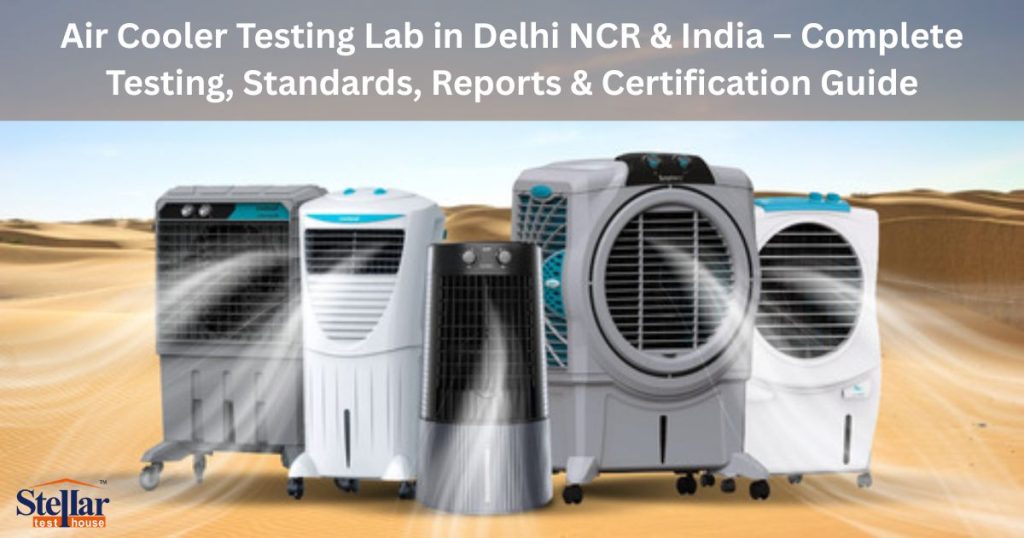
Air coolers are among the most widely used cooling appliances in India, especially in regions where high temperatures and dry weather conditions make them an affordable alternative to air conditioners. However, manufacturing or selling an air cooler is not just about design and performance. It must also meet quality, safety, durability, and efficiency requirements defined under applicable Indian standards.
This is where an Air Cooler Testing Lab plays a critical role.
Whether you are a manufacturer, importer, OEM supplier, startup brand, government procurement vendor, or institutional buyer, understanding air cooler testing requirements can help you avoid product failures, customer complaints, and compliance issues.
In this comprehensive guide, we will explain everything about Air cooler testing, applicable standards including IS 3315:2024, testing parameters, reports, certification requirements, and how to choose the right Air cooler testing lab in Delhi/NCR or anywhere in India.
Why Air Cooler Testing Is Important
Imagine launching a new air cooler model into the market after months of product development. Sales start strong, but within a few weeks customers begin reporting motor failures, excessive noise, water leakage, or poor cooling performance.
Such issues can damage brand reputation and lead to costly product returns.
Professional testing helps identify these problems before the product reaches customers.
Air cooler testing helps manufacturers:
- Verify product performance
- Improve product reliability
- Meet Indian standards requirements
- Reduce warranty claims
- Ensure electrical and mechanical safety
- Build customer trust
- Support certification and government tenders
- Enhance market acceptance
For buyers and procurement agencies, test reports provide confidence that the product performs as claimed.
What Is an Air Cooler Testing Lab?
An Air cooler testing lab is a specialized laboratory equipped to evaluate the performance, safety, durability, construction quality, and compliance of air coolers according to relevant standards and testing procedures.
These laboratories use calibrated instruments, environmental testing equipment, electrical testing systems, and performance measurement tools to generate reliable test reports.
Testing may be conducted for:
- Desert air coolers
- Personal air coolers
- Tower air coolers
- Commercial air coolers
- Industrial air coolers
- Portable evaporative coolers
Applicable Standard: IS 3315:2024
One of the most important standards for air coolers in India is:
IS 3315:2024 – Air Coolers Specification
IS 3315:2024 provides requirements related to:
- Construction
- Materials
- Workmanship
- Safety requirements
- Performance evaluation
- Functional testing
- Marking and labeling requirements
- Quality verification
Manufacturers seeking quality assurance and compliance should ensure their products are tested according to the latest version of IS 3315:2024.
Why IS 3315:2024 Matters
The updated standard helps establish:
- Uniform product quality
- Consistent testing methods
- Consumer safety
- Reliable performance assessment
- Better industry benchmarking
For manufacturers supplying products to institutional buyers, government departments, or large retail chains, compliance with IS 3315:2024 can become a significant competitive advantage.
Major Air Cooler Testing Parameters
A comprehensive Air cooler testing program generally includes multiple evaluations.
1. Cooling Performance Test
Cooling efficiency is one of the most critical performance indicators.
Laboratories evaluate:
- Temperature reduction capability
- Air delivery effectiveness
- Cooling consistency
- Operating stability
The results help determine whether the cooler meets expected performance levels.
2. Air Delivery Test
Airflow directly impacts cooling effectiveness.
Parameters measured include:
- Air volume delivery
- Air velocity
- Fan performance
- Distribution uniformity
Higher airflow generally improves cooling coverage.
3. Water Tank Capacity Verification
Testing laboratories verify:
- Actual tank volume
- Water holding capability
- Leakage resistance
- Overflow protection
Manufacturers often advertise specific capacities, and testing confirms those claims.
4. Power Consumption Test
Energy efficiency has become increasingly important for consumers.
Testing evaluates:
| Parameter | Purpose |
|---|---|
| Input Power | Measures energy consumption |
| Operating Current | Checks electrical load |
| Voltage Performance | Evaluates stability |
| Efficiency Assessment | Reviews energy usage |
Accurate power consumption data supports product labeling and marketing claims.
5. Electrical Safety Testing
Safety testing helps protect users from electrical hazards.
Typical evaluations include:
- Insulation resistance
- Leakage current
- Earthing continuity
- Electrical component verification
- Shock protection assessment
These tests are essential for consumer safety.
6. Motor Performance Testing
The motor is the heart of an air cooler.
Testing includes:
- Motor efficiency
- Operating temperature
- Starting performance
- Load endurance
- Continuous operation behavior
A reliable motor significantly increases product life.
7. Noise Level Testing
Excessive noise often leads to customer dissatisfaction.
Laboratories measure:
- Operating sound levels
- Fan noise
- Vibration-related noise
- Performance under different operating conditions
Lower noise levels improve user experience.
8. Durability and Endurance Testing
Long-term reliability is a major concern for manufacturers.
Durability testing may include:
- Continuous operation cycles
- Mechanical stress testing
- Component endurance
- Repeated usage simulation
These tests help identify weak points before market launch.
9. Structural Integrity Testing
The physical construction of the cooler is also evaluated.
Testing may cover:
- Body strength
- Impact resistance
- Wheel durability
- Handle strength
- Assembly quality
This is particularly important for portable air coolers.
10. Water Leakage Assessment
Water leakage is among the most common customer complaints.
Laboratories inspect:
- Tank sealing
- Pipe connections
- Pump operation
- Overflow control systems
Proper testing reduces after-sales issues.
Air Cooler Testing Process in India
Understanding the testing workflow helps manufacturers plan product development more effectively.
Step 1: Sample Submission
The manufacturer submits:
- Product sample
- Technical specifications
- User manual
- Product drawings (if required)
Step 2: Test Planning
Laboratory experts review:
- Applicable standards
- Testing requirements
- Product category
- Customer objectives
Step 3: Laboratory Testing
The sample undergoes various performance and safety evaluations.
Step 4: Data Analysis
Engineers analyze:
- Measured values
- Compliance status
- Performance observations
Step 5: Test Report Generation
The laboratory issues a detailed report documenting:
- Test methods
- Results
- Observations
- Compliance findings
Air Cooler Testing Lab in Delhi/NCR
Manufacturers often prefer an Air cooler testing lab in Delhi/NCR because the region is a major industrial and commercial hub.
Benefits of Choosing a Delhi NCR Testing Lab
- Faster sample transportation
- Better accessibility
- Availability of advanced testing infrastructure
- Faster report turnaround
- Support for manufacturers across North India
Industries from Delhi, Noida, Gurugram, Faridabad, Ghaziabad, Sonipat, Panipat, and surrounding regions regularly use testing services in the NCR area.
Air Cooler Testing India: Growing Demand for Compliance
The demand for air cooler testing India has increased significantly due to:
- Growing consumer awareness
- Quality-focused retail chains
- E-commerce product scrutiny
- Government procurement requirements
- Increased competition among manufacturers
Today’s buyers compare products based on specifications, reviews, reliability, and performance. Independent testing provides credibility that marketing claims alone cannot achieve.
Who Needs Air Cooler Testing?
Many businesses assume testing is only for large manufacturers.
In reality, testing benefits organizations of all sizes.
Manufacturers
Testing helps:
- Improve product quality
- Reduce defects
- Validate design performance
Importers
Importers can verify:
- Product safety
- Technical specifications
- Supplier claims
OEM Suppliers
OEM manufacturers often require testing before supplying products to major brands.
Government Vendors
Tender submissions frequently require supporting technical documentation and test reports.
Retail Chains
Large retailers increasingly demand verified quality data before onboarding products.
Key Documents Required for Air Cooler Testing
Requirements may vary depending on the laboratory and testing scope.
Common documents include:
| Document | Purpose |
|---|---|
| Product Specification Sheet | Technical information |
| User Manual | Operating instructions |
| Product Photographs | Identification |
| Manufacturer Details | Traceability |
| Bill of Materials | Component review |
| Sample Unit | Physical testing |
Providing complete documentation can speed up the testing process.
How to Choose the Right Air Cooler Testing Lab
Not all laboratories offer the same level of expertise or infrastructure.
Before selecting a lab, evaluate the following factors.
Technical Capability
Ensure the laboratory can perform testing according to applicable standards, including IS 3315:2024.
Equipment Availability
Modern instruments improve measurement accuracy and reliability.
Experienced Engineers
Qualified testing professionals help ensure accurate interpretation of results.
Report Acceptance
Confirm that the test reports are accepted by customers, procurement agencies, or certification bodies where required.
Turnaround Time
Product launch schedules often depend on timely testing completion.
Customer Support
A responsive laboratory can help clarify testing requirements and compliance questions.
Common Issues Found During Air Cooler Testing
Based on industry experience, laboratories frequently identify:
- Inadequate airflow performance
- Excessive power consumption
- Poor motor durability
- Water leakage
- Weak structural components
- Noise and vibration issues
- Labeling deficiencies
- Safety non-conformities
Detecting these issues early saves significant costs compared to post-market corrections.
Practical Tips for Manufacturers Before Testing
Many first-time manufacturers fail tests due to avoidable mistakes.
Consider these recommendations:
Conduct Internal Pre-Testing
Check major performance parameters before submitting samples.
Review Design Documentation
Ensure specifications match actual product performance.
Verify Electrical Components
Use reliable motors, pumps, switches, and wiring systems.
Focus on Build Quality
Small defects often become major compliance issues during testing.
Test Production Samples
Avoid submitting specially modified units that differ from production models.
Consistency is critical for long-term quality management.
Future Trends in Air Cooler Testing
The air cooler industry continues to evolve.
Emerging focus areas include:
- Energy-efficient designs
- Smart air coolers
- IoT-enabled monitoring
- Improved airflow engineering
- Sustainable materials
- Enhanced safety features
Testing methodologies are also becoming more sophisticated to address these innovations.
Why Independent Testing Builds Customer Trust
Consumers today have access to endless product choices.
A professionally tested product demonstrates that the manufacturer values:
- Quality
- Transparency
- Safety
- Performance
Independent testing reports can become powerful tools for marketing, distributor confidence, and institutional sales.
Rather than relying solely on promotional claims, verified data provides measurable proof of product capability.
Conclusion
Air coolers remain one of India’s most popular cooling solutions, but market success depends on much more than attractive design and competitive pricing. Quality, safety, durability, and performance play a decisive role in customer satisfaction and brand reputation.
Professional Air cooler testing helps manufacturers validate product performance, identify weaknesses, and ensure compliance with relevant requirements such as IS 3315:2024. Whether you are a startup brand, established manufacturer, importer, or government supplier, working with a reliable Air cooler testing lab can significantly improve product quality and market acceptance.
If you are looking for an Air cooler testing lab in Delhi/NCR or anywhere in India, choose a laboratory with strong technical capabilities, experienced engineers, modern infrastructure, and recognized testing procedures. Investing in testing before market launch is often far less expensive than dealing with product failures after launch.
Well-executed testing is not just a compliance activity—it is a strategic investment in product quality, customer trust, and long-term business growth.
FAQs
What is an Air Cooler Testing Lab?
An Air Cooler Testing Lab is a specialized facility that evaluates air coolers for performance, safety, durability, airflow, power consumption, and compliance with applicable standards such as IS 3315:2024.
Which standard is used for air cooler testing in India?
The primary standard used for air cooler evaluation is IS 3315:2024, which specifies requirements related to construction, performance, safety, workmanship, and testing methods.
Why is air cooler testing important for manufacturers?
Air cooler testing helps manufacturers verify product quality, improve reliability, reduce warranty claims, ensure safety, and support certification or procurement requirements.
How long does air cooler testing take?
The testing duration depends on the scope of testing, laboratory workload, and product complexity. Basic evaluations may take a few days, while comprehensive testing programs may require longer timelines.
Can startups and small manufacturers get air cooler testing done?
Yes. Air cooler testing is beneficial for startups, OEM suppliers, importers, and small manufacturers who want to validate product quality and build market credibility.
Is a test report useful for government tenders and institutional sales?
Yes. Many procurement agencies, institutional buyers, and large organizations prefer or require technical test reports to verify product performance and compliance before purchase decisions.