
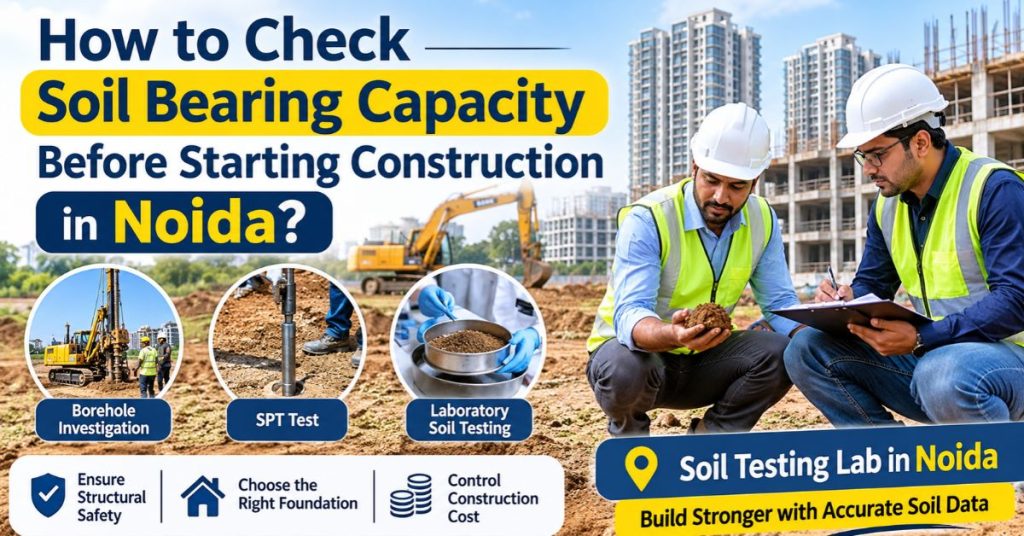
Before starting any construction project, one of the most important things a builder or property owner should understand is whether the soil can safely support the proposed structure. A plot may look strong and stable from the surface, but the soil beneath it can have different layers, moisture conditions and load-bearing characteristics.
This is why checking soil bearing capacity becomes an essential step before designing foundations or starting excavation work.
In a developing city like Noida, where residential buildings, commercial complexes, industrial units and infrastructure projects continue to grow, proper soil investigation plays an important role in construction planning. A professional soil testing lab in Noida can help builders, civil engineers and developers understand ground conditions before making important foundation decisions.
But how exactly do you check soil bearing capacity? Which tests are required, and when should you contact a geotechnical testing laboratory?
Let’s understand the process step by step.
What Is Soil Bearing Capacity?
Soil bearing capacity refers to the ability of soil to support the loads transferred by a building or other structure through its foundation without causing excessive settlement or shear failure.
In simple terms, it tells engineers how much load the ground can safely carry.
Every construction project transfers weight to the ground. This includes:
- Dead loads from columns, beams, walls and slabs.
- Live loads from people, furniture, machinery and equipment.
- Additional loads caused by wind and other structural forces.
If the soil cannot support these loads properly, the building may experience uneven settlement, foundation cracks, tilting or structural instability.
Therefore, engineers need reliable soil investigation results before selecting the foundation type and designing its dimensions.
Why Is Soil Bearing Capacity Testing Important Before Construction in Noida?
Noida has a mix of residential sectors, commercial developments, industrial areas and large construction projects. Soil conditions can vary from one plot to another, even within the same locality.
Assuming that nearby buildings have similar soil conditions can create problems during foundation design.
Here are some important reasons why soil bearing capacity testing matters.
1. Helps Select the Right Foundation
A geotechnical investigation helps engineers decide whether isolated footings, combined footings, raft foundations or pile foundations may be suitable for a project.
2. Reduces the Risk of Foundation Settlement
Weak or compressible soil can cause differential settlement. Testing helps engineers identify potential ground-related issues before construction begins.
3. Supports Structural Safety
Accurate soil investigation data allows structural engineers to calculate foundation dimensions based on actual ground conditions.
4. Helps Control Construction Costs
A proper investigation can prevent unnecessary excavation, over-designed foundations and expensive corrective work later.
5. Supports Building and Infrastructure Projects
Builders, developers and contractors need dependable soil data for residential buildings, commercial properties, factories, warehouses, roads and other infrastructure projects.
How to Check Soil Bearing Capacity Before Starting Construction?
Checking soil bearing capacity requires more than a simple surface inspection. A professional geotechnical investigation follows a systematic process to understand the soil profile and determine its suitability for the proposed construction.
Here are the major steps involved.
Step 1: Conduct a Preliminary Site Inspection
The first step involves examining the construction site and understanding its existing conditions.
During the inspection, engineers consider:
- Existing ground levels and site topography.
- Nearby buildings and visible foundation problems.
- Previous land use and any signs of filled soil.
- Drainage conditions and waterlogging.
- Nearby water bodies and groundwater conditions.
This initial assessment helps the investigation team plan the appropriate testing methods.
Step 2: Perform Soil Investigation Through Boreholes
Borehole investigation helps engineers understand the different soil layers beneath the ground surface.
The testing team drills boreholes at selected locations and depths according to the project’s requirements. During this process, they collect soil samples and record changes in soil strata.
This investigation helps identify:
- Sandy soil and clayey soil layers.
- Loose and dense soil conditions.
- Soft or compressible soil deposits.
- Groundwater table levels.
- Variations in soil properties at different depths.
For multi-storey buildings, commercial complexes and industrial structures, borehole investigation provides valuable information for foundation planning.
Step 3: Conduct Standard Penetration Test (SPT)
The Standard Penetration Test (SPT) is a commonly used field investigation method for evaluating subsurface soil conditions.
During this test, a standard split-spoon sampler enters the soil using a specified hammer arrangement. Engineers record the number of blows required for penetration over the relevant test intervals.
The resulting N-value helps engineers assess soil resistance and relative density in granular soils. It also contributes to evaluating the consistency of cohesive soils when interpreted appropriately.
SPT results, along with soil samples and laboratory findings, help geotechnical engineers estimate soil parameters required for foundation design.
Step 4: Perform Laboratory Soil Testing
Field investigation alone does not always provide all the information needed for foundation design. Engineers also require laboratory testing to understand the physical and engineering properties of collected soil samples.
Common laboratory soil tests include:
| Soil Test | Purpose |
|---|---|
| Grain Size Analysis | Determines the distribution of soil particles |
| Atterberg Limits | Evaluates soil plasticity and consistency |
| Moisture Content Test | Measures the water content in soil |
| Specific Gravity Test | Determines the specific gravity of soil particles |
| Bulk and Dry Density | Evaluates soil density characteristics |
| Compaction Test | Determines optimum moisture content and maximum dry density |
| Direct Shear Test | Evaluates soil shear strength parameters |
| Triaxial Test | Determines soil strength and stress-strain behaviour |
These results help engineers understand how the soil may behave under different loading and moisture conditions.
Step 5: Conduct Plate Load Test Where Required
A Plate Load Test helps evaluate the load-settlement behaviour of soil at the test location and depth.
In this method, engineers place a steel plate on a prepared soil surface and apply loads in stages. They measure the corresponding settlement under each load.
The observations help engineers assess:
- Soil response under applied pressure.
- Settlement characteristics.
- Pressure-settlement relationship.
- Field performance of the tested ground.
The Plate Load Test can provide useful site-specific information, but engineers must consider its limitations, including the influence of plate size and the depth of the soil being investigated.
Step 6: Calculate Safe Bearing Capacity
After completing the required field and laboratory investigations, geotechnical engineers interpret the results to estimate the soil’s bearing capacity.
Two important terms are:
- Ultimate Bearing Capacity: The maximum pressure the soil can sustain before shear failure.
- Allowable Bearing Pressure: The pressure permitted for foundation design after considering appropriate safety against shear failure and settlement limitations.
For practical foundation design, engineers must consider both shear strength and permissible settlement.
The final design value depends on soil properties, groundwater conditions, foundation dimensions, depth and the nature of the proposed structure.
Which Soil Tests Are Required for Different Construction Projects?
Not every construction project requires the same investigation programme. The testing requirements depend on building height, structural loads, site conditions and project specifications.
| Construction Project | Common Investigation Requirements |
|---|---|
| Residential House | Borehole investigation, SPT and relevant laboratory tests |
| Multi-Storey Building | Detailed boreholes, SPT, soil strength and settlement assessment |
| Commercial Complex | Geotechnical investigation based on structural loading |
| Industrial Building | Soil investigation considering machinery and structural loads |
| Warehouse | Soil strength, density and settlement evaluation |
| Road Construction | Soil classification, compaction and CBR testing |
| Infrastructure Project | Site-specific geotechnical investigation and engineering assessment |
A qualified geotechnical engineer should finalize the testing scope according to the project requirements. Avoid selecting tests only because they were used at another construction site.
What Factors Affect Soil Bearing Capacity in Noida?
Soil bearing capacity does not remain the same across all locations. Several natural and site-related factors influence how much load the ground can support.
1. Soil Type: Dense sand, stiff clay, loose sand and soft clay have different engineering properties and load-bearing behaviour.
2. Moisture Content: Changes in moisture can affect soil strength, particularly in certain clayey soils.
3. Groundwater Level: A high groundwater table can influence effective soil strength, excavation conditions and foundation performance.
4. Soil Density: Loose soil may experience greater settlement than properly compacted or naturally dense soil under similar conditions.
5. Foundation Depth: The depth and dimensions of a foundation influence the pressure distribution and bearing behaviour of the supporting soil.
6. Previous Land Use: Sites with uncontrolled filling, debris or disturbed ground may require additional investigation before construction.
Understanding these factors helps developers make informed decisions and avoid unnecessary foundation-related risks.
How to Choose the Best Soil and Geotechnical Testing Laboratory in Noida?
Selecting the right testing laboratory is an important decision for builders, architects, contractors and property developers.
The quality of the investigation report directly influences engineering decisions, so do not select a laboratory based only on the lowest quotation.
Consider these points before finalizing a laboratory:
- Relevant Testing Experience: Choose a laboratory with experience in soil investigation and geotechnical testing for construction projects.
- Technical Capabilities: Check whether it can conduct the required field and laboratory tests.
- Qualified Technical Team: Look for trained field personnel and competent technical professionals.
- Testing Standards: Confirm that the laboratory follows applicable IS codes and project specifications.
- Accreditation and Approval: Verify current NABL accreditation, if required, and check whether the specific tests fall within its approved scope.
- Detailed Test Reports: Ensure that the laboratory provides clear test observations, results and relevant technical details.
If you are searching for a govt soil testing lab near me, first understand whether your project requires a government laboratory specifically or an appropriately qualified and accredited private laboratory. Always verify the laboratory’s current credentials and testing scope before placing an order.
Why Choose Stellar Test House for Soil and Geotechnical Testing?
Stellar Test House provides testing and technical support for construction, infrastructure and industrial projects.
Located in Sector 63, Noida, Stellar Test House supports clients who require reliable testing services for building materials, soil and other construction-related requirements.
Whether you are planning a residential building, commercial complex, industrial facility or infrastructure project, professional soil investigation can help you understand site conditions before foundation work begins.
Why consider Stellar Test House?
- Soil and geotechnical testing services.
- Testing support for construction and infrastructure projects.
- Technical testing facilities for different engineering requirements.
- Testing based on applicable standards and project specifications.
- Support for builders, contractors, developers and engineering professionals.
If you are looking for a soil testing lab in Noida, contact Stellar Test House to discuss your project requirements and the appropriate soil testing services.
Laboratory Details:
- Company: Stellar Test House
- Address: G-68, G-Block, Sector 63, Noida, Uttar Pradesh – 201301
- Website: https://stellartesthouse.com
- Email: [email protected]
Conclusion
Checking soil bearing capacity before construction is not just a technical requirement; it is an important step towards building a safe and durable structure. Proper soil investigation helps builders understand ground conditions, select suitable foundations and reduce the possibility of unexpected settlement problems.
For construction companies, property developers, architects and civil engineers planning projects in Noida, choosing the right soil testing lab in Noida can make a significant difference in construction planning.
Get your site investigated before starting construction. Contact Stellar Test House to discuss your soil and geotechnical testing requirements and take the first step towards a well-planned foundation.
Frequently Asked Questions (FAQs)
1. How can I check soil bearing capacity before construction?
You can check soil bearing capacity through a professional geotechnical investigation involving borehole drilling, Standard Penetration Test (SPT), laboratory soil testing and, where required, Plate Load Testing. Engineers evaluate the results to determine suitable foundation design parameters.
2. Is soil testing necessary before constructing a house in Noida?
Yes. Soil investigation helps identify ground conditions, soil strength, groundwater levels and potential settlement issues. It provides important information for designing a safe and suitable foundation.
3. Which soil test is best for checking bearing capacity?
There is no single test suitable for every site. SPT, Plate Load Test, direct shear test and triaxial testing can contribute to bearing capacity assessment. The appropriate combination depends on soil conditions and project requirements.
4. What is the difference between soil testing and geotechnical investigation?
Soil testing generally refers to individual field and laboratory tests used to determine soil properties. Geotechnical investigation is a broader process that includes site assessment, subsurface exploration, soil testing and engineering interpretation for foundation design.
5. When should builders contact a soil testing laboratory?
Builders should contact a soil testing laboratory during the planning stage, before finalizing foundation design and starting major excavation or construction activities.
6. Can soil bearing capacity vary between two nearby plots in Noida?
Yes. Even nearby plots can have different soil layers, groundwater conditions, fill materials and density. Therefore, engineers should evaluate each construction site based on its own investigation results.