
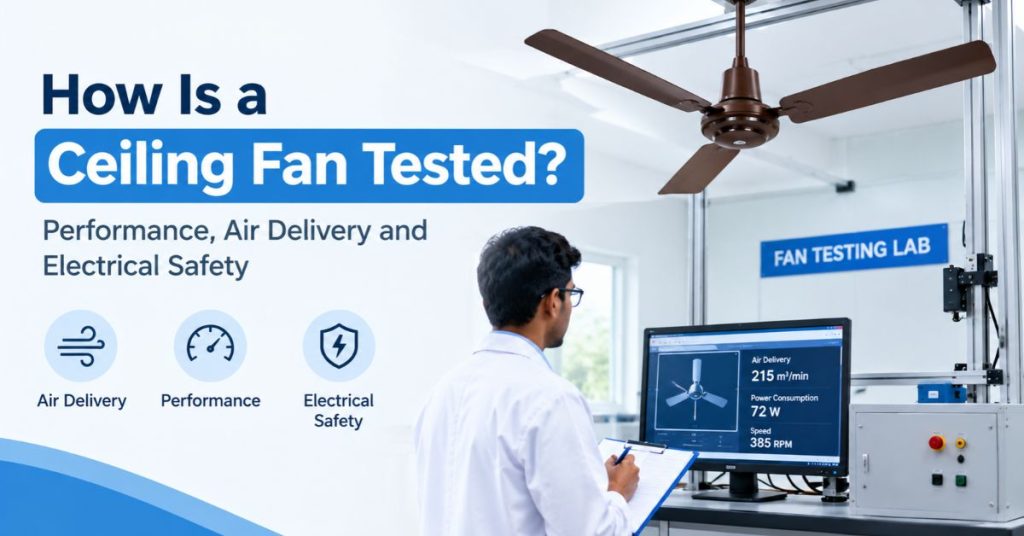
A ceiling fan may look like a simple household appliance, but its performance depends on several important factors, including air delivery, rotational speed, power consumption, mechanical strength, and electrical safety. A fan that looks good and runs smoothly does not always deliver the expected airflow or meet the required safety standards.
This is why manufacturers need reliable product testing before introducing ceiling fans to the market. A professional fan testing lab helps evaluate a fan’s performance, identify potential defects, and verify its compliance with applicable technical requirements.
For manufacturers, importers, and product developers, understanding the testing process also makes it easier to select the right fan testing laboratory for their products.
What Is Ceiling Fan Testing?
Ceiling fan testing is the process of evaluating a fan’s operating performance, airflow, electrical characteristics, and safety under defined test conditions. The laboratory examines whether the product performs as intended and meets the relevant requirements for its category.
During domestic appliance testing, laboratories may evaluate different household electrical products, including ceiling fans, table fans, pedestal fans, mixer grinders, and other appliances, depending on their testing capabilities.
A professional ceiling fan testing lab follows appropriate test methods and applicable product standards to assess the fan’s performance and safety. In India, IS 374 is an important standard associated with electric ceiling fans. The applicable edition and requirements depend on the product and the relevant regulatory framework.
Why Is a Fan Testing Lab Important?
For a manufacturer, product quality involves more than appearance and price. Customers expect their fans to provide sufficient airflow, operate efficiently, and work safely over time.
Working with a qualified fan testing lab offers several benefits:
- Performance evaluation: Testing helps determine whether the fan delivers the expected airflow and operating performance.
- Electrical safety: Appropriate checks help identify electrical hazards and potential insulation-related issues.
- Quality improvement: Test results can highlight design or manufacturing problems before wider distribution.
- Product development: Manufacturers can use test findings to improve motor design, blade geometry, and overall performance.
- Compliance support: Testing helps manufacturers assess their products against applicable standards and regulatory requirements.
- Reliable documentation: A laboratory report records the results of the tests performed within the agreed scope.
Testing does not automatically guarantee product certification or regulatory approval. Manufacturers should confirm which tests, approvals, or certification procedures apply to their specific products.
Key Parameters Evaluated During Ceiling Fan Testing
A ceiling fan testing laboratory examines different technical parameters according to the product category, applicable standards, and requested testing scope.
1. Air Delivery Testing
Air delivery is one of the most important performance parameters of a ceiling fan. It indicates the volume of air the fan moves under specified test conditions.
During air delivery testing, the laboratory uses an appropriate test setup and measurement method to determine the fan’s airflow performance. The results help manufacturers understand whether their products meet the intended performance requirements.
Air delivery can be affected by several factors, including blade design, blade angle, rotational speed, motor characteristics, and the overall construction of the fan.
A manufacturer can use these results to improve blade geometry and optimize the fan’s performance.
2. Rotational Speed Testing
Rotational speed refers to how quickly the fan blades rotate, generally measured in revolutions per minute (RPM).
A laboratory measures the fan’s speed under specified operating conditions. Depending on the design, testing may cover different speed settings.
The results help manufacturers evaluate the fan’s operating characteristics and compare its performance with the relevant specifications.
3. Power Consumption Testing
Power consumption indicates how much electrical power a fan uses during operation. It is an important consideration for consumers who want dependable cooling without unnecessary electricity costs.
During this test, the laboratory measures the fan’s electrical input using suitable instruments under defined conditions.
Manufacturers can use the findings to assess the relationship between power consumption and air delivery. This information may also support product development aimed at improving energy performance.
Actual electricity consumption depends on the fan’s operating conditions, speed setting, and duration of use.
4. Electrical Safety Testing
Electrical safety is essential because a ceiling fan operates using mains electricity and contains electrical and mechanical components.
Depending on the applicable standard and test scope, electrical safety assessments may include:
- Insulation resistance testing
- Electric strength or dielectric withstand testing
- Leakage current assessment, where applicable
- Earthing continuity checks for products that require protective earthing
- Examination of wiring, connections, and accessible electrical parts
- Assessment of protection against electric shock
These tests help identify potential hazards and evaluate whether the product meets the relevant safety requirements. The exact test sequence and acceptance criteria depend on the applicable standard and the fan’s design.
A competent fan testing laboratory uses suitable equipment and documented procedures to obtain reliable results.
5. Mechanical Strength and Structural Checks
A ceiling fan contains rotating blades, a motor assembly, mounting components, and other mechanical parts. These components must withstand the stresses associated with normal operation and applicable test conditions.
Mechanical assessments may cover blade security, mounting arrangements, relevant strength requirements, and other construction-related checks specified by the applicable standard.
The laboratory selects the necessary tests according to the product design and testing scope. These evaluations help manufacturers identify weaknesses that could affect product safety or durability.
6. Noise and Vibration Assessment
Excessive noise or vibration can reduce user comfort and may indicate a balancing or assembly issue.
Where required, the laboratory can evaluate noise or vibration using appropriate methods and equipment. The results may help manufacturers investigate blade imbalance, motor-related noise, loose components, or other design and manufacturing issues.
Not every testing assignment includes noise and vibration measurements. The laboratory should confirm the relevant scope before testing begins.
7. Temperature Rise and Operating Performance
Electrical and mechanical components may generate heat during operation. Temperature-related testing, where applicable, helps evaluate whether components remain within the limits specified by the relevant requirements.
A laboratory may operate the fan under defined conditions and measure temperatures at specified points. These findings help manufacturers assess thermal performance and identify potential design concerns.
The test conditions and acceptance limits depend on the applicable product standard.
Step-by-Step: How Is a Ceiling Fan Tested?
Although the exact procedure varies by product and standard, a typical testing process follows several stages.
Step 1: Product and document review
The manufacturer shares the fan model details, technical specifications, rated voltage, rated power, drawings where necessary, and requested tests. The laboratory reviews the information to establish the appropriate testing scope.
Step 2: Sample receipt and identification
The laboratory receives the sample and records the relevant identification details. It may also examine the product’s construction and general condition before testing begins.
Step 3: Selection of test methods
The laboratory identifies the applicable standards, test procedures, equipment, and acceptance criteria. The requirements should match the product category and the purpose of the assessment.
Step 4: Performance measurements
The laboratory performs the agreed performance tests, which may include air delivery, rotational speed, and power consumption measurements.
Step 5: Electrical and mechanical assessments
The laboratory conducts the applicable electrical safety, construction, and mechanical checks according to the approved testing plan.
Step 6: Result evaluation
The measured values are reviewed against the relevant requirements and declared specifications. Any limitations, deviations, or observations are documented as appropriate.
Step 7: Laboratory report
After completing the agreed tests, the laboratory issues a report containing the applicable sample details, methods, results, and other required information. The report should clearly reflect the tests actually performed and their outcomes.
How to Choose the Right Ceiling Fan Testing Lab
Selecting a suitable laboratory is an important decision for manufacturers and product developers. The right choice depends on the type of fan, the required tests, and the intended use of the results.
Before selecting a ceiling fan testing lab, consider these points:
- Relevant testing scope: Confirm that the laboratory performs the specific fan performance and safety tests you require.
- Applicable standards: Ask which standards and editions the laboratory uses for your product.
- Accreditation status: Verify the laboratory’s current accreditation and whether the relevant tests fall within its accredited scope.
- Equipment and facilities: Check that the laboratory has appropriate equipment for the requested measurements.
- Reporting process: Understand the expected report format, documentation requirements, and turnaround time.
- Sample requirements: Confirm the number of samples, accessories, and technical documents needed before submitting your product.
Manufacturers should not assume that every laboratory offers every type of fan test. Confirming the scope in advance helps avoid delays and unnecessary costs.
Fan Testing Services at Stellar Test House
Stellar Test House provides testing services across various product and material categories. Manufacturers looking for fan testing or broader domestic appliance testing can contact the laboratory to discuss their product, testing requirements, and applicable standards.
Before submitting a ceiling fan, share the product specifications, model details, and required tests. The laboratory can then help clarify the available testing scope, sample requirements, and relevant documentation.
For businesses searching for a fan testing lab in Noida or the Delhi-NCR region, confirming the laboratory’s current capabilities and accreditation scope is an important first step.
Stellar Test House
G-68, G-Block, Sector 63, Noida, Uttar Pradesh – 201301
Website: https://stellartesthouse.com/
Email: [email protected]
Contact the team to discuss your ceiling fan testing requirements and determine the appropriate next steps.
Conclusion
Ceiling fan testing helps manufacturers evaluate airflow, electrical performance, mechanical construction, and safety before bringing their products to market. Each test provides useful information that can support product development and quality assurance.
Choosing a capable fan testing lab makes it easier to understand a product’s performance and identify areas that may need improvement. Whether you need air delivery measurements, electrical safety assessments, or a broader domestic appliance testing service, confirm the applicable requirements and laboratory scope before proceeding.
For ceiling fan testing inquiries, contact Stellar Test House to discuss your product and testing needs.
Frequently Asked Questions (FAQs)
1. What does a fan testing lab test?
A fan testing lab may evaluate air delivery, rotational speed, power consumption, electrical safety, mechanical strength, and other parameters, depending on the applicable standard and agreed testing scope.
2. What is the difference between a fan testing lab and a domestic appliance testing laboratory?
A fan testing lab focuses on fan-related performance and safety assessments. A domestic appliance testing laboratory may cover a wider range of household electrical products, depending on its facilities and approved testing scope.
3. Which standard is used for ceiling fan testing in India?
IS 374 is an important Indian Standard associated with electric ceiling fans. Manufacturers should verify the applicable edition and any current mandatory certification requirements for their specific product.
4. Why is air delivery testing important for ceiling fans?
Air delivery testing helps determine how much air a fan moves under defined conditions. It provides useful information for performance evaluation, product comparisons, and design improvements.
5. What documents are required for fan testing?
Requirements vary, but laboratories may request product specifications, model details, rated electrical information, technical drawings where relevant, and details of the tests required. Confirm the exact requirements before sending samples.
6. How can manufacturers select a reliable fan testing laboratory?
Manufacturers should check the laboratory’s relevant testing scope, equipment, applicable standards, accreditation status, sample requirements, and reporting process before booking the tests.