
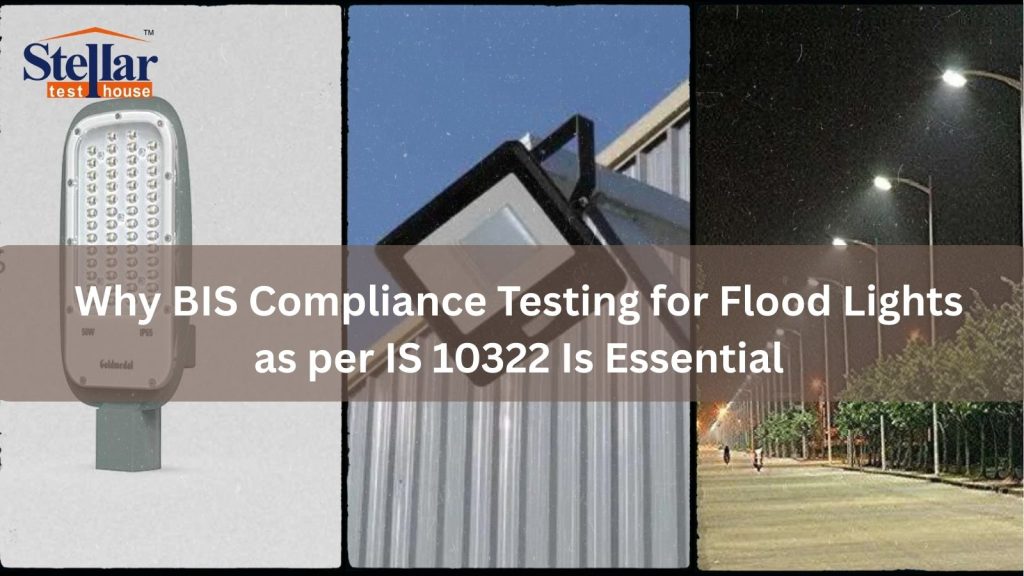
Flood lights play a vital role in providing high-intensity illumination for outdoor areas, industrial sites, stadiums, and commercial complexes. With increasing demand for energy-efficient and safe lighting solutions, ensuring that these luminaires meet regulatory standards is critical. This is where BIS compliance testing under IS 10322 (Part 5 / Sec 5):2013 + A1:2018 becomes indispensable.
In this article, we explore why flood light testing as per IS 10322 is essential and how certified laboratories help manufacturers maintain quality, safety, and efficiency.
Understanding IS 10322 Part 5 Sec 5 Standard
IS 10322 Part 5 Sec 5 standard defines the performance, safety, and operational requirements for flood lights and similar outdoor lighting equipment. Unlike basic safety checks, this standard evaluates:
- Electrical performance under various load conditions
- Light intensity and distribution
- Durability and resistance to environmental factors
- Energy efficiency and operational reliability
Testing according to this standard ensures that flood lights perform safely, efficiently, and consistently in real-world conditions.
Why BIS Compliance Is Critical
The Bureau of Indian Standards (BIS) mandates that all electrical lighting equipment sold in India meet specific benchmarks. Compliance testing provides several key benefits:
- Safety Assurance – Confirms the flood light operates without electrical hazards such as short circuits, overheating, or insulation failure.
- Performance Reliability – Verifies brightness, uniformity, and light coverage as per design specifications.
- Energy Efficiency – Ensures power consumption aligns with declared values, helping reduce electricity costs and environmental impact.
- Market Acceptance – BIS-certified products gain consumer trust and are legally permitted for sale in India.
Skipping compliance testing can lead to product rejection, recalls, and reputational damage.
Key Testing Parameters for Flood Lights
A professional flood light performance testing laboratory evaluates several critical aspects of a luminaire:
- Electrical Characteristics – Voltage, current, and insulation resistance
- Luminous Performance – Lux levels, beam angle, and uniformity
- Thermal Behavior – Heat dissipation and stability under continuous operation
- Mechanical Durability – Resistance to vibration, impact, and environmental conditions
- Ingress Protection – Water and dust resistance for outdoor applications
These evaluations are conducted in controlled environments, often in an LED flood light testing lab or electrical lighting equipment testing laboratory, to ensure accurate, repeatable results.
Role of IS 10322 Labs in Noida
Selecting a certified IS 10322 lab in Noida offers manufacturers several advantages:
- Quick access to BIS-approved testing services
- Expert engineers familiar with luminaires testing as per IS 10322
- Calibrated equipment for precise measurements
- Efficient test reports for faster certification
Working with a trusted lab helps manufacturers identify design gaps early and reduce the risk of non-compliance.
Benefits Beyond Compliance
Testing flood lights as per IS 10322 not only ensures regulatory approval but also adds value in multiple ways:
- Improves product reliability and lifespan
- Reduces warranty claims and returns
- Enhances brand credibility in the market
- Supports energy conservation initiatives
Manufacturers who prioritize performance testing often enjoy higher customer satisfaction and repeat business.
Conclusion
BIS compliance testing for flood lights as per IS 10322 is not optional; it is a necessity for safety, efficiency, and market credibility. Conducting tests in a flood light performance testing laboratory or LED flood light testing lab ensures products meet the highest standards of quality and reliability.