
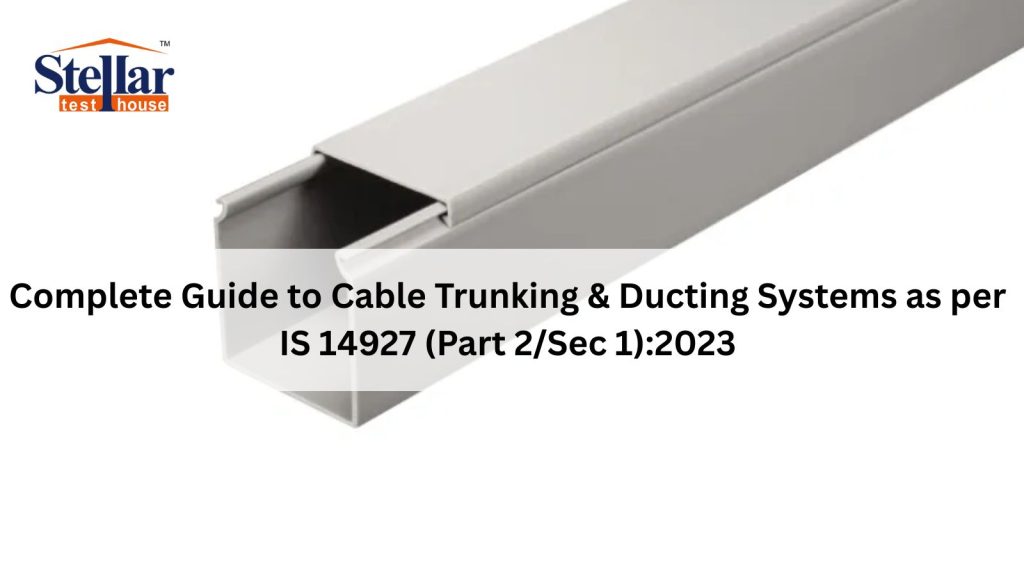
In modern electrical installations, cable trunking and ducting systems play a critical role in safety, organization, and long-term reliability. With the introduction of IS 14927 (Part 2/Sec 1):2023, manufacturers, contractors, and project consultants must ensure full compliance with updated Indian standards.
This guide explains the standard in simple terms, highlights testing requirements, and shows why choosing the right IS 14927 testing lab in Noida is essential for certification and market acceptance.
What Are Cable Trunking & Ducting Systems?
Cable trunking and ducting systems are protective enclosures used to route, support, and safeguard electrical cables. These systems are widely used in:
- Commercial buildings
- Industrial plants
- Data centers
- Residential and infrastructure projects
They help reduce mechanical damage, improve fire safety, and make maintenance easier.
Overview of IS 14927 (Part 2/Sec 1):2023
IS 14927 is the Indian Standard that specifies requirements for cable management systems.
Part 2, Section 1 (2023) focuses on cable trunking and ducting systems, particularly non-metallic types.
The standard defines:
- Material performance
- Mechanical strength
- Resistance to heat and fire
- Dimensional accuracy
- Safety under real operating conditions
Compliance is verified only through a recognized IS 14927 cable trunking testing laboratory.
Why IS 14927:2023 Compliance Is Important
Non-compliant cable trunking systems can lead to:
- Electrical hazards
- Fire risks
- Project rejection
- Failure in BIS or client audits
Testing ensures that products perform reliably over time and meet national safety expectations. Most government and private projects now demand reports from an IS 14927 Part 2 Section 1 testing lab before approval.
Key Testing Requirements Under IS 14927 (Part 2/Sec 1):2023
Testing is conducted under controlled laboratory conditions to evaluate real-world performance.
1. Mechanical Strength Test
This test checks the ability of trunking systems to withstand impact and load during installation and service.
2. Heat Resistance Test
The system is exposed to elevated temperatures to confirm it does not deform or crack.
3. Fire Propagation Test
This test ensures that cable trunking does not contribute to flame spread, improving overall fire safety.
4. Insulation & Electrical Safety
Electrical properties are verified to prevent short circuits and insulation failure.
5. Dimensional Accuracy & Finish
Precise dimensions ensure compatibility with accessories and proper cable fitting.
All these evaluations are carried out at a certified electrical cable trunking testing laboratory.
Who Needs IS 14927 Testing?
IS 14927 testing is essential for:
- Cable trunking manufacturers
- Electrical accessory manufacturers
- EPC contractors
- Exporters and OEM suppliers
- Infrastructure and real estate developers
For smooth certification, testing must be conducted at a NABL approved cable trunking testing laboratory in Noida or an equivalent accredited facility.
Importance of Choosing the Right Testing Lab
Not all labs offer the same level of expertise or accreditation. A professional Cable Trunking and Ducting Systems Testing Lab in Noida provides:
- NABL-accredited test reports
- Compliance with the latest IS 14927:2023 version
- Accurate, repeatable test results
- Faster turnaround time
- Technical guidance for manufacturers
Selecting a trusted IS 14927 Cable Trunking Testing Lab reduces the risk of retesting and certification delays.
Why Noida Is a Preferred Testing Hub
Noida has emerged as a key center for industrial testing due to:
- Proximity to manufacturers
- Advanced testing infrastructure
- Availability of NABL-approved laboratories
- Faster logistics and sample handling
A cable ducting system testing lab in Noida offers both technical expertise and operational convenience.
Testing Process at an IS 14927 Testing Laboratory
The typical testing workflow includes:
- Sample submission
- Test plan review as per IS 14927 (Part 2/Sec 1):2023
- Physical and electrical testing
- Data analysis and verification
- Issuance of final NABL-approved test report
Each stage is documented carefully to meet audit and regulatory requirements.
Common Causes of Test Failure
Manufacturers often face failure due to:
- Low-quality raw materials
- Improper wall thickness
- Poor fire-retardant properties
- Inadequate mechanical strength
Early testing at an IS 14927 Part 2 Sec 1 Cable Trunking Testing Lab helps identify these issues before mass production.
How IS 14927 Testing Adds Market Value
Compliance with IS 14927:2023:
- Improves product credibility
- Builds trust with clients and consultants
- Enables participation in government tenders
- Reduces liability and safety risks
Certified products stand out in a competitive market.
Final Thoughts
IS 14927 (Part 2/Sec 1):2023 is more than a regulatory requirement—it is a benchmark for safety, quality, and performance. Proper testing ensures that cable trunking and ducting systems meet modern electrical installation demands.
Working with a NABL approved cable trunking testing laboratory in Noida ensures accuracy, compliance, and confidence in your product.
If you are looking for Cable Trunking & Ducting Systems Testing as per IS 14927:2023, always choose a laboratory with proven expertise, accreditation, and a strong understanding of Indian standards.