
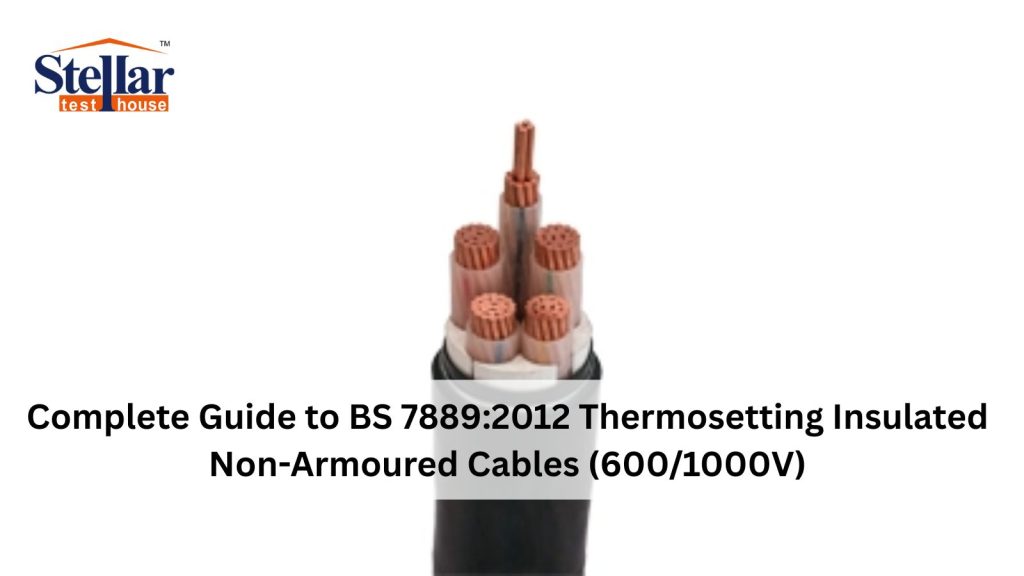
Electrical safety and long-term performance depend heavily on choosing the right cable for the right application. One such important standard in low-voltage power distribution is BS 7889:2012, which defines requirements for thermosetting insulated, non-armoured cables designed for fixed installation with a working voltage up to and including 600/1000V.
This guide explains the standard in simple terms, covers real-world applications, and highlights why testing through a certified BS 7889 Testing Lab is essential for manufacturers, suppliers, and project engineers.
Understanding BS 7889:2012 Standard
BS 7889:2012 is a British Standard that specifies construction, performance, and testing requirements for thermosetting insulated cables intended for fixed electrical installations.
These cables are commonly used in:
- Commercial buildings
- Industrial plants
- Infrastructure projects
- Control panels and switchgear
Unlike armoured cables, these are non-armoured cables for fixed installation, making them lighter, more flexible, and easier to install in protected environments.
What Is a Thermosetting Insulated Cable (600/1000V)?
A thermosetting insulated cable 600/1000V uses insulation materials such as XLPE (Cross-Linked Polyethylene) or EPR, which do not soften when exposed to heat. This property gives the cable superior thermal stability and long service life.
Key Benefits:
- High resistance to heat and deformation
- Better electrical performance under load
- Improved mechanical strength
- Suitable for continuous operation at higher temperatures
These advantages make thermosetting cables ideal for demanding electrical installations.
Non-Armoured Cable for Fixed Installation: Where Are They Used?
A non armoured cable for fixed installation lab typically tests cables meant for locations where mechanical protection is provided externally, such as:
- Cable trays
- Conduits
- Trunking systems
- Indoor installations
Since these cables do not have metallic armour, they are not intended for direct burial or harsh outdoor conditions without protection.
Construction of BS 7889:2012 Cables
A typical thermosetting non armoured power cable includes:
1. Conductor
- Copper or aluminium
- Solid, stranded, or flexible depending on application
2. Insulation
- Thermosetting material (XLPE/EPR)
- Rated for 600/1000V fixed installation cable applications
3. Sheath (if applicable)
- PVC or LSZH
- Provides environmental and chemical protection
Each layer plays a critical role in ensuring safety, efficiency, and durability.
Voltage Rating: 600/1000V Explained
The 600/1000V rating indicates:
- 600V between conductor and earth
- 1000V between conductors
This voltage range suits:
- Power distribution circuits
- Control wiring
- Industrial electrical systems
Cables must undergo strict verification at a 600/1000V fixed installation cable lab to ensure compliance before use.
Why Testing Is Mandatory for BS 7889:2012 Cables
Compliance with BS 7889:2012 is not just a formality—it is a safety requirement. Testing confirms that cables can withstand electrical, thermal, and mechanical stress throughout their service life.
A certified BS 7889:2012 cable Testing Lab performs a series of checks before approval.
Key Tests Performed in a BS 7889 Testing Lab
A professional Thermosetting non armoured power cable laboratory conducts the following tests:
Conductor Resistance Test
Ensures proper conductivity and minimal power loss.
Insulation Resistance Test
Verifies insulation integrity under voltage stress.
High Voltage (Dielectric) Test
Confirms the cable can safely handle its rated voltage.
Thermal Aging Test
Evaluates long-term performance at elevated temperatures.
Mechanical Strength Test
Checks resistance to bending and physical stress.
Only cables that pass all these tests receive compliance certification.
Importance of Choosing the Right Testing Laboratory
Selecting an experienced BS 7889 Testing Lab ensures:
- Accurate test results
- Compliance with international standards
- Acceptance by regulatory authorities
- Reduced project risk
For manufacturers and suppliers in North India, a BS 7889 Testing Lab in Noida offers fast turnaround, technical expertise, and local support for compliance needs.
Applications of BS 7889:2012 Thermosetting Cables
These cables are widely used in:
- Power distribution boards
- Industrial machinery
- Commercial buildings
- Utility and infrastructure projects
- Control and instrumentation systems
Their reliability makes them a preferred choice for long-term fixed installations.
Common Mistakes to Avoid
- Using non-armoured cables in unprotected outdoor conditions
- Skipping third-party testing
- Selecting cables without proper voltage rating
- Ignoring sheath material suitability
Proper testing at a recognized BS 7889:2012 cable Testing Lab eliminates these risks.
Final Thoughts
The BS 7889:2012 thermosetting insulated non-armoured cable (600/1000V) standard plays a vital role in ensuring safe and efficient electrical installations. From construction quality to performance under stress, every detail matters.
Whether you are a manufacturer, contractor, or project consultant, working with a trusted BS 7889 Testing Lab in Noida or any accredited BS 7889 Testing Lab ensures compliance, safety, and confidence in your electrical systems.