
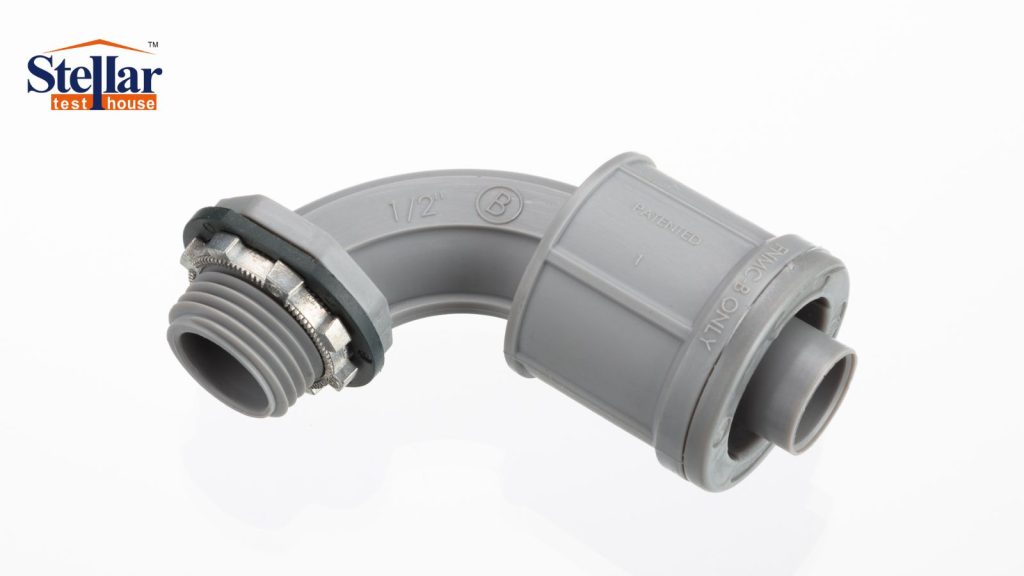
Rigid non-metallic conduit fittings play a vital role in protecting electrical wiring systems in residential, commercial, and industrial installations. To ensure safety, durability, and performance, these fittings must comply with IS 3419:1988, the Indian Standard that defines testing requirements for fittings used with rigid non-metallic conduits.
At Stellar Test House, testing is carried out with precision, technical expertise, and strict adherence to standards. This article explains how rigid PVC conduit fittings testing is performed as per IS 3419:1988, and why selecting a reliable, accredited laboratory matters.
Understanding IS 3419:1988 for Conduit Fittings
IS 3419:1988 specifies construction, performance, and testing requirements for fittings designed for rigid non-metallic conduits, commonly made of PVC. These fittings include couplers, bends, inspection boxes, junction boxes, and accessories used to join or terminate conduits.
The standard ensures that conduit fittings:
- Maintain mechanical strength
- Provide proper protection to cables
- Perform reliably under installation and service conditions
Compliance with this standard is essential for manufacturers supplying products to regulated electrical projects.
Why Testing of Rigid PVC Conduit Fittings Is Important
Electrical conduit fittings experience mechanical stress during installation and service. Poor-quality fittings may crack, deform, or fail, leading to unsafe wiring conditions.
Testing conducted at an IS 3419:1988 Testing Laboratory helps:
- Verify product quality and consistency
- Reduce electrical hazards
- Meet regulatory and tender requirements
- Build trust with contractors and end users
For these reasons, manufacturers rely on certified test reports from recognized laboratories.
How Rigid PVC Conduit Fittings Are Tested as per IS 3419:1988
At Stellar Test House, testing follows a systematic and standard-compliant approach. Each test evaluates a specific performance aspect of conduit fittings.
1. Visual and Dimensional Examination
Testing begins with a detailed visual inspection. Engineers check fittings for surface defects, uniformity, and workmanship. Dimensional measurements confirm compatibility with rigid non-metallic conduits.
Accurate dimensions ensure proper jointing and alignment during installation.
2. Mechanical Strength Testing
Mechanical performance is critical for conduit fittings. During rigid PVC conduit fittings testing, samples undergo tests to evaluate resistance to mechanical stress.
These tests confirm that fittings can withstand:
- Installation forces
- External pressure
- Normal handling conditions
This step prevents cracking or failure during real-world use.
3. Impact Resistance Test
Impact resistance testing determines how fittings respond to sudden mechanical shock. The test simulates accidental impacts that may occur during installation or maintenance.
Conduit fittings must retain structural integrity after impact, ensuring continued protection of electrical cables.
4. Heat Resistance and Thermal Stability
Rigid non-metallic conduit fittings often operate in environments with fluctuating temperatures. IS 3419:1988 requires thermal performance evaluation to confirm that fittings do not deform or lose strength under heat exposure.
This test ensures long-term performance in electrical installations.
5. Resistance to Deformation and Assembly Fit
Fittings must maintain their shape when assembled with conduits. Testing confirms proper fit, alignment, and resistance to deformation during jointing.
Correct assembly prevents loose connections and improves system reliability.
Role of a NABL Accredited Testing Laboratory
Selecting a NABL Accredited Lab for IS 3419 Conduit Fittings is essential for reliable compliance. NABL accreditation confirms that the laboratory follows internationally accepted testing practices and quality systems.
As an IS 3419:1988 Conduit Fittings Testing Laboratory, Stellar Test House provides:
- Calibrated testing equipment
- Qualified technical professionals
- Standard-compliant test procedures
- Traceable and credible test reports
Reports issued by accredited laboratories carry higher acceptance among certification bodies and regulatory authorities.
Why Choose Stellar Test House for IS 3419:1988 Testing
Stellar Test House operates as a trusted IS 3419:1988 Testing Laboratory, offering accurate and transparent testing services for rigid non-metallic conduit fittings.
Key advantages include:
- Strong expertise in electrical accessory testing
- Comprehensive testing under one roof
- Clear documentation and reporting
- Timely support for manufacturers and suppliers
Our focus remains on delivering technically sound results that support product compliance and market acceptance.
Conclusion
Testing fittings for rigid non-metallic conduits as per IS 3419:1988 ensures safety, durability, and regulatory compliance. From dimensional checks to mechanical and thermal performance evaluation, each test plays a critical role in product quality assurance.
By choosing Stellar Test House, manufacturers gain access to a reliable IS 3419:1988 Conduit Fittings Testing Laboratory that combines technical accuracy with accredited credibility. Proper testing not only meets standard requirements but also strengthens confidence in electrical installation systems