
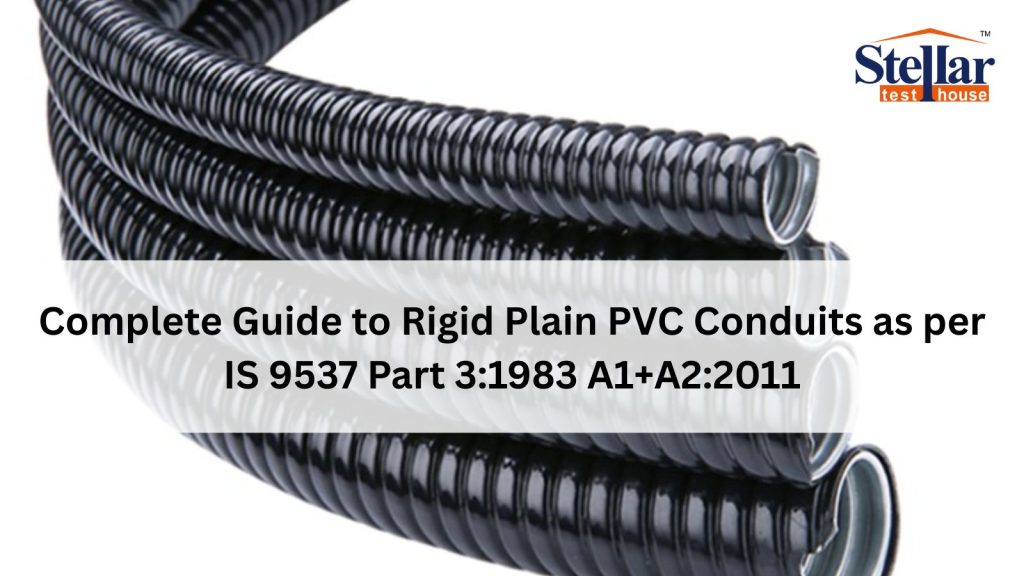
Rigid plain PVC conduits form the backbone of safe and organized electrical installations in residential, commercial, and industrial buildings. These conduits protect electrical wiring from mechanical damage, moisture, and external stress while ensuring long-term safety. To maintain consistent quality and performance, the Bureau of Indian Standards introduced IS 9537 Part 3:1983, along with amendments A1 and A2 (2011), which define the requirements for rigid plain conduits made from insulating materials such as PVC.
This complete guide explains the standard, its testing requirements, and the importance of choosing a reliable testing partner like Stellar Test House.
What Are Rigid Plain PVC Conduits?
Rigid plain PVC conduits are non-metallic conduits manufactured from polyvinyl chloride. These conduits are widely used for surface and concealed electrical wiring systems due to their corrosion resistance, insulation properties, and ease of installation.
Under rigid plain PVC conduits IS 9537, the standard ensures that conduits provide adequate mechanical strength, insulation resistance, and fire safety for electrical installations.
Overview of IS 9537 Part 3:1983 A1+A2:2011
IS 9537 Part 3 specifies the technical and performance requirements for rigid plain conduits used in electrical wiring. The amendments A1 and A2 updated test methods and acceptance limits to align with modern safety expectations and field conditions.
Compliance with this standard is essential for:
- PVC conduit manufacturers
- Electrical contractors
- Builders and infrastructure developers
- BIS license holders
Testing as per this standard ensures uniform quality across products supplied to the market.
Why IS 9537 Part 3 Testing Is Important
Electrical conduits play a direct role in fire safety and electrical reliability. Substandard conduits can crack, deform, or fail under load, leading to wiring damage and safety hazards.
IS 9537 PVC conduit quality testing helps manufacturers:
- Meet BIS compliance requirements
- Ensure long-term conduit performance
- Avoid rejection during inspection or audits
- Build customer and regulatory trust
Key Testing Requirements Under IS 9537 Part 3
1. Dimensional Verification
The conduit must meet specified outer diameter, wall thickness, and straightness requirements. Accurate dimensions ensure proper installation and fitting compatibility.
2. Mechanical Strength Testing
Rigid Plain PVC Conduits Testing as per IS 9537 includes impact resistance and compression tests. These tests verify that conduits can withstand mechanical stress during installation and service life.
3. Insulation Resistance Test
As insulating materials, PVC conduits must offer high electrical resistance. This test confirms that the conduit does not allow unintended current flow, improving electrical safety.
4. Heat Resistance and Deformation Test
Rigid conduits are exposed to varying temperatures. Testing ensures that the conduit does not soften, deform, or lose structural integrity under elevated temperature conditions.
5. Fire Resistance Characteristics
Electrical installations demand materials that do not promote flame spread. Fire-related tests ensure that PVC conduits behave safely during abnormal thermal conditions.
6. Overall Quality Assessment
Final inspection verifies compliance with all parameters defined under IS 9537 Part 3 before approval.
Role of a Specialized Testing Laboratory
Testing rigid PVC conduits requires calibrated equipment, trained professionals, and a clear understanding of BIS standards. Choosing the right lab ensures accurate results and reliable compliance.
A professional PVC Conduit BIS Standard Testing Laboratory provides structured testing, documented results, and traceable reports accepted by authorities and clients.
IS 9537 Part 3 PVC Conduit Testing Lab in Noida
Manufacturers located in Noida and NCR benefit from working with a local laboratory. Faster sample movement, direct coordination, and quicker reporting help maintain production timelines.
IS 9537 Part 3 PVC conduit testing Noida services offered by Stellar Test House support manufacturers, suppliers, and contractors with dependable and timely testing solutions.
As a recognized BIS PVC conduit testing lab Noida, Stellar Test House assists clients throughout their compliance and quality assurance process.
Why Choose Stellar Test House?
Stellar Test House is a trusted name in material and product testing, offering specialized services for electrical and construction materials.
Key advantages:
- Expertise in Rigid PVC Electrical Conduit Testing IS 9537
- Dedicated testing facilities for PVC conduits
- Skilled technical professionals
- Accurate, traceable, and timely test reports
- Strong focus on BIS and IS standard compliance
Whether you need routine testing or project-specific evaluation, Stellar Test House delivers reliable results you can trust.
Who Needs IS 9537 Part 3 Testing?
- PVC conduit manufacturers
- BIS license applicants
- Electrical product suppliers
- Infrastructure and construction companies
- Government and private project contractors
Testing ensures that products meet safety, durability, and regulatory requirements before market supply or installation.
Conclusion
Rigid plain PVC conduits play a vital role in protecting electrical wiring systems. Compliance with IS 9537 Part 3:1983 A1+A2:2011 ensures that these conduits perform safely and reliably throughout their service life.
Through structured testing, quality verification, and regulatory support, Stellar Test House helps manufacturers and suppliers meet BIS requirements with confidence. If you are looking for a reliable IS 9537 Part 3 PVC Conduit Testing Lab or a dependable IS 9537 Part 3 PVC Conduit Testing Lab in Noida, Stellar Test House is fully equipped to support your testing needs.