
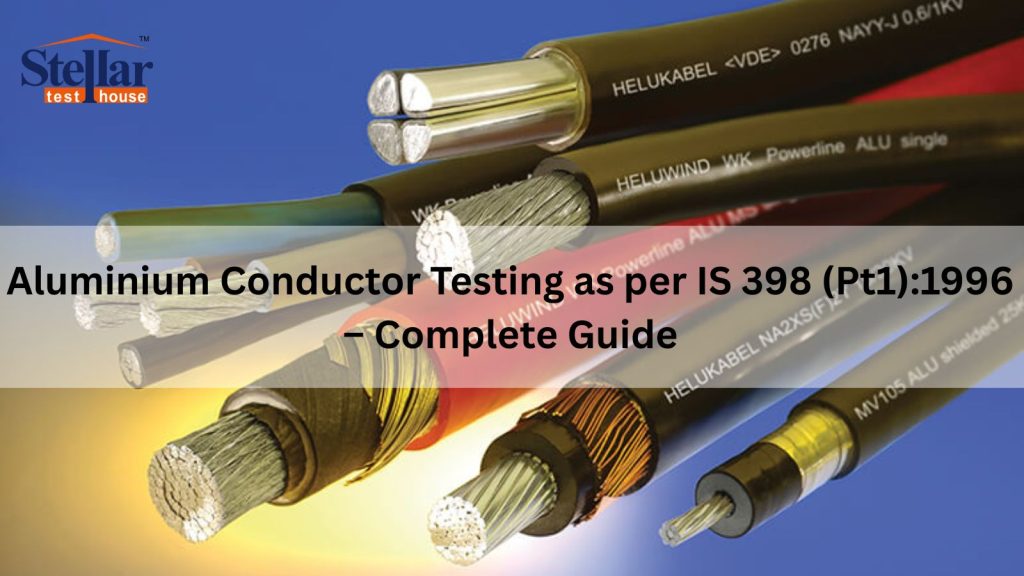
Aluminium conductors play a vital role in overhead power transmission systems across India. Their lightweight nature, good conductivity, and cost efficiency make them a preferred choice for utilities and infrastructure projects. However, performance and safety depend heavily on quality compliance. This is where Aluminium Conductor Testing as per IS 398 (Pt1):1996+A1:1999 becomes essential.
This guide explains why testing matters, what tests are performed, and how a certified IS 398 Testing Lab ensures reliable results.
Understanding IS 398 (Pt1):1996 Standard
IS 398 (Part 1) specifies requirements for Aluminium Stranded Conductors used in overhead transmission lines. The standard defines material quality, construction, dimensional tolerances, and mechanical and electrical properties.
Manufacturers, EPC contractors, and power distribution companies rely on this standard to ensure that conductors can withstand mechanical stress, environmental conditions, and long-term service demands.
Why Aluminium Conductor Testing Is Important
Without proper testing, conductors may fail under load, sag excessively, or lose conductivity over time. These failures can cause power losses, outages, or safety hazards.
Testing verifies that:
- Raw materials meet purity requirements
- Stranding and dimensions follow the standard
- Mechanical strength supports overhead installation
- Electrical performance meets conductivity limits
A professional Aluminium Conductor Testing Lab helps identify defects before installation, saving both cost and risk.
Key Tests Performed as per IS 398 (Pt1)
A certified IS 398 Aluminium Testing Laboratory performs several mandatory tests to ensure compliance:
1. Dimensional and Construction Test
This test checks the number of strands, strand diameter, and overall conductor diameter. Accuracy here ensures proper mechanical performance during stringing and service life.
2. Tensile Strength Test
The conductor must withstand specified tensile loads without failure. This test confirms that the aluminium strands provide sufficient mechanical strength for overhead transmission lines.
3. Electrical Resistance Test
Electrical resistance is measured to verify conductivity limits. Higher resistance leads to energy loss, so this test is critical for efficient power transmission.
4. Wrapping and Bending Test
The conductor is wrapped around a mandrel to check flexibility and surface integrity. Cracks or breaks indicate poor material quality.
5. Material Quality Verification
Chemical composition and surface condition are examined to ensure the aluminium meets standard requirements.
All these tests are conducted under controlled conditions in an accredited Overhead Transmission Conductor Testing Lab.
Role of a Certified Testing Laboratory
A reliable Aluminium Conductor Testing Services provider follows standardized procedures, uses calibrated equipment, and maintains detailed test records. Test results are documented clearly, which helps manufacturers and clients meet regulatory and tender requirements.
Testing accuracy is ensured through trained personnel and strict quality control systems. Reports issued by a recognized IS 398 Testing Lab are widely accepted by government departments, utilities, and private project owners.
Who Needs Aluminium Conductor Testing?
Aluminium conductor testing is essential for:
- Conductor manufacturers
- Power transmission and distribution companies
- EPC contractors
- Government and utility projects
- Export-oriented suppliers
Testing is often mandatory before dispatch or installation, especially for large infrastructure projects.
Choosing the Right Aluminium Conductor Testing Lab
When selecting a testing laboratory, consider:
- Accreditation and compliance with IS standards
- Experience in Aluminium Stranded Conductor Testing
- Availability of complete IS 398 test facilities
- Clear and timely reporting
A competent laboratory ensures confidence in product quality and long-term performance.
Conclusion
Aluminium Conductor Testing as per IS 398 (Pt1):1996 is not just a formality—it is a critical quality assurance step for overhead transmission systems. Proper testing protects infrastructure, improves efficiency, and ensures safety throughout the conductor’s service life.
By working with a trusted Aluminium Conductor Testing Lab, manufacturers and project owners can ensure full compliance with IS 398 and deliver reliable power transmission solutions.