
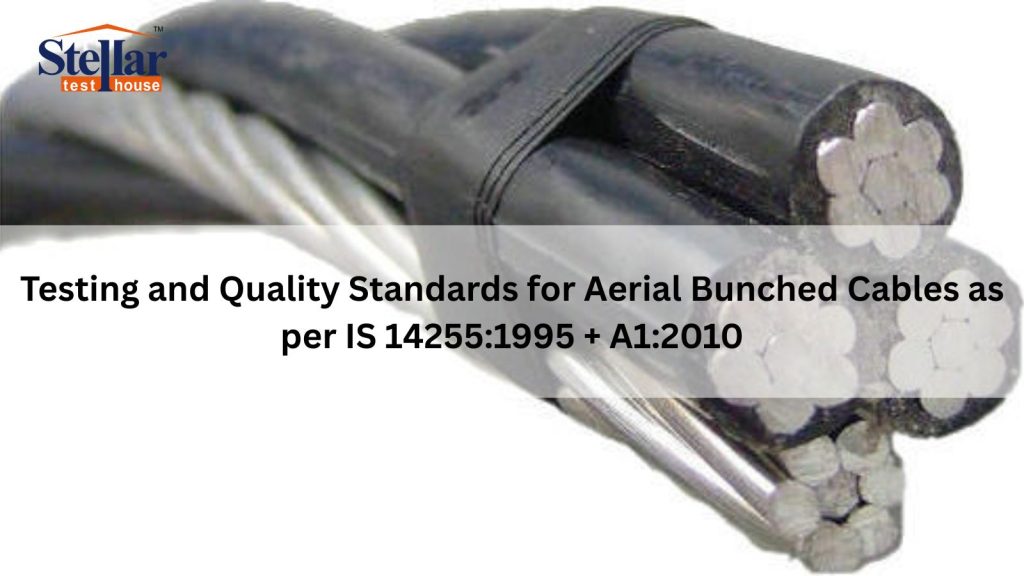
Aerial Bunched Cables (ABC) have become the preferred choice for modern power distribution systems due to their safety, durability, and performance in harsh outdoor conditions. For working voltages up to 1100 volts, the Indian Standard IS 14255:1995 + A1:2010 defines strict requirements for design, construction, and testing. Ensuring that each cable meets these parameters is essential for reliability and long-term efficiency.
If you are searching for an Aerial Bunched Cable IS 14255 testing lab or want clarity on the exact testing procedures, this article will guide you through the essential quality standards, mandatory tests, and why lab-certified cables matter for both procurement and compliance.
Why Testing of Aerial Bunched Cables Matters
Aerial Bunched Cables are used in:
- LT distribution lines
- Urban and rural electrification
- Power supply in congested areas or difficult terrains
- Temporary and permanent power connections
Since these cables carry voltages up to 1100V, ensuring they comply with IS 14255 is crucial for:
- Preventing power losses
- Avoiding breakdowns
- Ensuring safety for linemen and end-users
- Enhancing lifespan and performance
A certified Aerial Bunched Cable 1100 Volt testing lab verifies that the cable meets national and utility standards before installation.
Key Requirements of IS 14255:1995 + A1:2010
The standard lays out detailed specifications related to:
- Conductor Material – Aluminium or stranded alloy
- Insulation – XLPE or equivalent UV-resistant insulation
- Messenger/Neutral Conductor – Galvanized or all-aluminium alloy
- Construction Requirements – Compactness, tensile strength, insulation thickness
- Performance Standards – Thermal behaviour, electrical resistance, mechanical stability
A reputable ABC Cable IS 14255:1995 lab ensures all these parameters align with the updated amendment (A1:2010).
Mandatory Tests Conducted as per IS 14255
To ensure the cable is safe and compliant, the following tests are carried out:
1. Routine Tests
Performed on every manufactured cable length:
- Conductor resistance test
- High-voltage test
- Insulation continuity and thickness verification
2. Type Tests
Conducted on representative samples to establish design reliability:
- Tensile strength and elongation test
- Hot set test for insulation
- UV ageing test
- Thermal stability test
- Flammability test
- Insulation resistance measurement
- Impulse voltage test
These tests ensure the cable can withstand real-world outdoor conditions like heat, rain, dust, and mechanical load.
3. Acceptance Tests
Performed on selected samples from a batch:
- Conductor dimensional check
- Insulation and sheath quality test
- Mechanical properties test
- High voltage withstand test
Every accredited Aerial Bunched Cable Specifications IS 14255 Lab follows strict protocols to ensure consistency and performance.
Why Choose a Certified Testing Laboratory?
Selecting a government-approved or NABL-accredited Aerial Bunched Cable IS 14255 testing lab ensures:
- Accurate test results
- Compliance with IS standards
- Quality verification for tenders and utility contracts
- Authentication for cable manufacturers and buyers
This also helps avoid failures in field conditions and ensures your project passes inspections smoothly.
Aerial Bunched Cable Price vs Testing
Many buyers compare Aerial Bunched Cable Price 1100V, but quality should never be compromised. A cable that fails to meet IS 14255 standards can lead to:
- Frequent outages
- Safety hazards
- Higher maintenance costs
- Reinstallation expenses
Testing ensures that the price you pay is for a cable that performs safely and reliably.
Conclusion
Ensuring that Aerial Bunched Cables meet the requirements of IS 14255:1995 + A1:2010 is essential for safe and dependable power distribution. Whether you are a contractor, utility provider, or manufacturer, partnering with a trusted Aerial Bunched Cable 1100 Volt testing lab guarantees that your cables meet all necessary mechanical, electrical, and safety standards.