
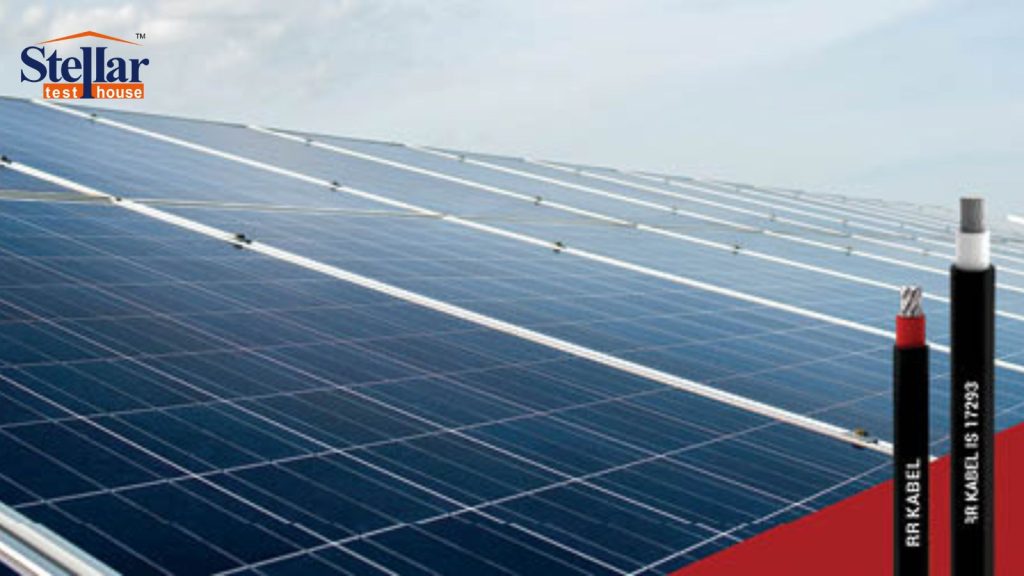
India’s solar industry has grown at a remarkable pace over the last decade. Large-scale solar parks, rooftop installations, and off-grid solutions continue to expand the nation’s renewable energy footprint. As the solar sector grows, the demand for safe, reliable, and high-performing components also increases. Among all the components used in solar installations, photovoltaic (PV) cables play a critical role.
To ensure cable safety and long-term durability, the Bureau of Indian Standards (BIS) introduced IS 17293:2020, the dedicated Indian Standard for photovoltaic cables.
This guide explains everything you need to know about IS 17293:2020—its purpose, specifications, cable construction, testing requirements, and why it is essential for solar manufacturers, EPCs, and installers across India.
Understanding IS 17293:2020
IS 17293:2020 is the official Indian Standard that defines the technical requirements for solar photovoltaic cables rated up to 1500V DC. These cables connect solar panels, inverters, junction boxes, and other balance-of-system components.
Solar cables face extreme outdoor conditions. They run across rooftops, ground-mount frames, and open fields under intense sunlight, heat, humidity, and dust. With time, temperature variations and UV exposure can degrade inferior cables, creating serious risks such as fire hazards or power loss.
IS 17293:2020 ensures PV cables can tolerate India’s harsh climate for 20–25 years, which matches the expected life of a solar power plant.
What Makes PV Cables Different?
PV cables differ from traditional electrical cables because they operate in outdoor environments and carry high DC voltage.
High-voltage DC behaves differently from AC. DC arcs can sustain longer, making cable quality even more important.
A high-quality PV cable must be:
- UV resistant
- Heat and flame resistant
- Highly flexible
- Weatherproof
- Mechanically strong
- Halogen-free to prevent harmful emissions
IS 17293:2020 ensures these characteristics are met.
Scope of IS 17293:2020
The standard applies to:
- Single-core flexible copper cables
- Rated for up to 1500V DC
- Designed for interconnection in photovoltaic systems
- Suitable for outdoor and rooftop installations
- Applicable to both ac and dc sides, wherever PV-specific cables are required
The standard covers the cable’s construction, materials, electrical properties, thermal performance, and mechanical characteristics.
Cable Construction Requirements Under IS 17293:2020
The structure of a compliant PV cable consists of three main components:
1. Conductor
- Must be made of tinned copper, which provides corrosion resistance.
- Class 5 flexible conductor.
- Ensures long-term current carrying efficiency.
2. Insulation
- Made from cross-linked polyolefin (XLPO).
- Offers thermal stability, UV resistance, and flame retardance.
- Works effectively under extreme temperature cycles.
3. Outer Sheath
- Also made from UV-resistant XLPO, ensuring durability in sunlight.
- Resistant to oil, ozone, and weathering.
- Halogen-free to minimize toxic smoke during fire incidents.
Together, these layers provide excellent electrical safety and mechanical performance.
Key Electrical and Mechanical Requirements
IS 17293:2020 defines strict performance criteria to ensure long service life.
Electrical Properties
- Must withstand 1500V DC without breakdown
- Low conductor resistance
- High insulation resistance
- Effective protection against short circuits
Thermal Performance
- Operating temperature: –40°C to +90°C
- Short-circuit temperature: up to 250°C
- Designed for long-term exposure to high temperatures on rooftops and open fields
Mechanical Properties
- High flexibility for easy installation
- Resistant to abrasion and mechanical shocks
- Must perform well under outdoor vibration, bending, and movement
Environmental Resistance
- UV-resistant
- Weatherproof
- Ozone-resistant
- Suitable for dry and wet conditions
These requirements help prevent failures such as insulation cracks, melting, and conductor corrosion.
Testing Requirements Under IS 17293:2020
Testing plays an essential role in verifying whether cables meet the standard.
A BIS-recognized laboratory conducts comprehensive tests on photovoltaic cables.
Here are the major tests required under IS 17293:2020:
1. Conductor Resistance Test
Ensures the cable can carry the expected current without heating or losses.
2. Insulation and Sheath Aging Tests
Simulates long-term outdoor exposure under heat and UV radiation.
3. High Voltage Withstand Test
The cable must remain stable when subjected to high DC voltage.
4. Tensile Strength and Elongation Test
Checks the mechanical durability and flexibility of the insulation and sheath.
5. UV Resistance Test
Ensures the outer sheath can tolerate intense sunlight.
6. Temperature Cycling
Cables undergo repeated heating and cooling to test durability.
7. Flame Retardancy Test
Verifies that the cable slows the spread of flames during fire incidents.
8. Ozone and Weathering Test
Simulates long-term outdoor effects on the cable sheath.
9. Shrinkage and Cold Bend Test
Ensures the cable performs well under extreme temperature variations.
These tests help manufacturers deliver cable quality that aligns with modern solar industry expectations.
Why IS 17293:2020 Compliance Matters
1. Enhanced Safety
Solar cables carry high DC voltage, and even minor insulation failure can cause electrical shocks or fires. Compliance ensures reliable insulation and mechanical strength.
2. Longer Lifespan
Approved cables are designed for a service life of 20–25 years, reducing maintenance expenses.
3. Higher Solar Plant Efficiency
Quality cables reduce power losses, enhancing the overall output of a solar system.
4. Mandatory for Many Projects
Several government and utility-scale solar tenders require IS 17293-compliant cables.
5. Better Investment Security
EPC companies and project owners avoid unexpected failures and downtime costs.
For manufacturers, compliance also opens doors to larger markets and long-term contracts.
Who Should Follow IS 17293:2020?
The standard is crucial for:
- Solar cable manufacturers
- EPC contractors
- Solar panel installers
- Inverter and BOS manufacturers
- Quality inspectors and certification bodies
Anyone involved in solar cable production or installation must understand this standard.
Role of Testing Laboratories
A NABL and BIS-recognized laboratory is essential for:
- Solar cable certification
- R&D quality improvement
- Testing for 1000V and 1500V DC systems
- Compliance with national and international PV cable standards
Such labs ensure cables meet India’s renewable energy demands safely and efficiently.
Conclusion
IS 17293:2020 is one of the most important standards in India’s solar ecosystem. It ensures photovoltaic cables perform reliably under harsh outdoor conditions and sustain long-term power generation.
Manufacturers, EPC companies, and installers must follow this standard to guarantee safety, efficiency, and long-lasting solar installations.