
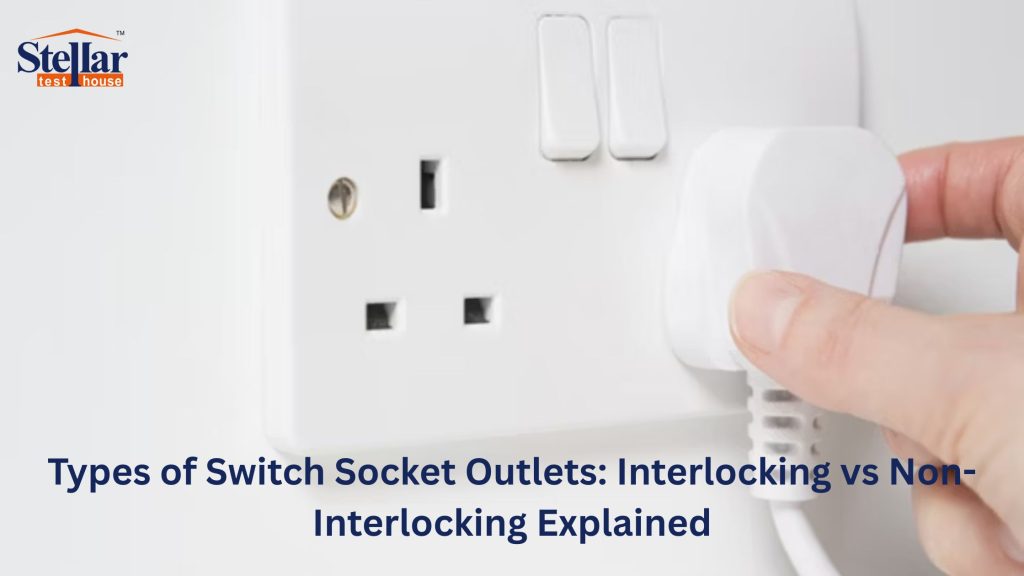
Electricity powers our homes, workplaces, and industries — but behind every safe electrical connection lies careful design, proper standards, and tested components. Among the most essential components in any electrical setup are Switch Socket Outlets (Interlocking & Non-Interlock type). These devices might look simple, but they play a crucial role in electrical safety, durability, and compliance with Indian and international standards.
In this article, we’ll explore the difference between interlocking and non-interlocking switch socket outlets, their uses, advantages, and the importance of proper testing and certification for these electrical devices.
1. What Are Switch Socket Outlets?
Switch socket outlets are devices that combine a switch and a socket in a single unit. They allow users to connect electrical appliances to the power supply safely and conveniently. You’ll find them in homes, offices, factories, and almost everywhere electricity is used.
The Bureau of Indian Standards (BIS) has specified detailed requirements for these outlets under Plugs and Socket-Outlets for Household and Similar Purposes of Rated Voltage up to and Including 250 V and Rated Current up to and Including 16 Amp.
This ensures that every plug and socket used in India is safe, reliable, and built to perform under typical Indian electrical conditions.
2. Classification of Switch Socket Outlets
There are mainly two types of Switch Socket Outlets (Interlocking & Non-Interlock type):
- Interlocking Type
- Non-Interlocking Type
Both serve similar purposes but differ in their safety features and internal design.
3. Interlocking Switch Socket Outlets
An interlocking switch socket outlet is designed with an additional safety mechanism that ensures the plug cannot be inserted or removed while the switch is in the ON position. This “interlock” prevents the flow of current during connection or disconnection, reducing the risk of electric shock or sparking.
Key Features:
- Mechanical interlock between switch and socket.
- Prevents live insertion or withdrawal.
- Commonly used in industrial or commercial applications.
- Provides enhanced electrical safety for high-power equipment.
Advantages:
- Prevents accidental disconnection under load.
- Reduces the risk of short circuits or electric shocks.
- Ensures operator safety in harsh or high-voltage environments.
Because of these advantages, Switch Socket Outlets (Interlocking & Non-Interlock type) with interlocking mechanisms are widely recommended in heavy-duty environments such as factories, testing laboratories, and workshops.
4. Non-Interlocking Switch Socket Outlets
A non-interlocking socket outlet does not have the safety interlock mechanism. The plug can be inserted or removed at any time, regardless of whether the switch is ON or OFF. These are commonly used in homes and light-duty applications where the risk of heavy load or electrical arcing is minimal.
Key Features:
- Simple and cost-effective design.
- Suitable for household and office appliances.
- Easy to install and replace.
Advantages:
- Affordable and widely available.
- Perfect for low-voltage domestic applications.
- Compact and aesthetically pleasing for modern interiors.
However, since they lack interlocking protection, proper testing and certification are essential to ensure safety during use.
5. Importance of Standards and Testing
Every electrical device must comply with recognized safety standards. In India, Plugs and Socket-Outlets for Household and Similar Purposes of Rated Voltage up to and Including 250 V and Rated Current up to and Including 16 Amp are tested as per IS 1293:2019 and related BIS standards.
Testing typically includes:
- Mechanical endurance testing (durability of insertion cycles).
- Insulation resistance testing (ensuring no leakage of current).
- Temperature rise testing (checking overheating under load).
- Earth continuity and contact resistance tests.
A certified testing laboratory, such as Stellar Test House, performs these evaluations to confirm that every switch socket outlet — whether interlocking or non-interlocking — meets the required safety and performance standards.
6. Role of Adhesive and Insulating Materials
In manufacturing and testing of electrical products, the use of Pressure sensitive adhesive tapes for Electrical Purposes also plays an important role. These tapes are used for insulation, wrapping, and protecting wires and joints within socket and plug assemblies.
High-quality Pressure sensitive adhesive tapes for Electrical Purposes must meet IS 7809 or equivalent standards to ensure they can withstand voltage stress, temperature variations, and moisture exposure. During product testing, these tapes are also inspected for adhesion strength, dielectric properties, and resistance to aging.
Thus, whether it’s a Switch Socket Outlet (Interlocking & Non-Interlock type) or a Plug and Socket-Outlets for Household and Similar Purposes of Rated Voltage up to and Including 250 V and Rated Current up to and Including 16 Amp, proper insulation using tested adhesive tapes ensures long-term safety and performance.
7. Testing and Certification by Accredited Laboratories
To sell or distribute electrical products in India, manufacturers must obtain BIS certification under the Compulsory Registration Scheme (CRS). Testing is conducted in BIS-recognized laboratories such as Stellar Test House, where products are evaluated according to Indian Standards (IS).
Our laboratory services include:
- Testing of Switch Socket Outlets (Interlocking & Non-Interlock type)
- Evaluation of Plugs and Socket-Outlets for Household and Similar Purposes of Rated Voltage up to and Including 250 V and Rated Current up to and Including 16 Amp
- Quality assessment of Pressure sensitive adhesive tapes for Electrical Purposes
With advanced equipment and experienced professionals, Stellar Test House ensures your products are compliant, safe, and ready for certification.
8. Why Testing Matters
Unsafe electrical devices can cause fires, shocks, or equipment failures. Testing provides assurance that the design and materials meet required safety standards. Whether you are a manufacturer, importer, or supplier, compliance testing builds trust, reduces liability, and supports market approval.
In short, proper testing of Switch Socket Outlets (Interlocking & Non-Interlock type) and related accessories is not just a regulatory requirement — it’s a commitment to safety and quality.
Conclusion
From households to heavy industries, switch socket outlets are an integral part of our electrical infrastructure. While interlocking outlets offer superior safety for demanding environments, non-interlocking types remain ideal for everyday household use.
No matter the type, all outlets must comply with BIS standards such as Plugs and Socket-Outlets for Household and Similar Purposes of Rated Voltage up to and Including 250 V and Rated Current up to and Including 16 Amp to ensure reliability and safety.
Supporting materials like Pressure sensitive adhesive tapes for Electrical Purposes also need to meet proper specifications for insulation and performance.
At Stellar Test House, we help manufacturers achieve compliance through precise testing, accurate reporting, and expert guidance — ensuring every electrical product that reaches the market is safe, efficient, and certified for use.